Key Takeaways
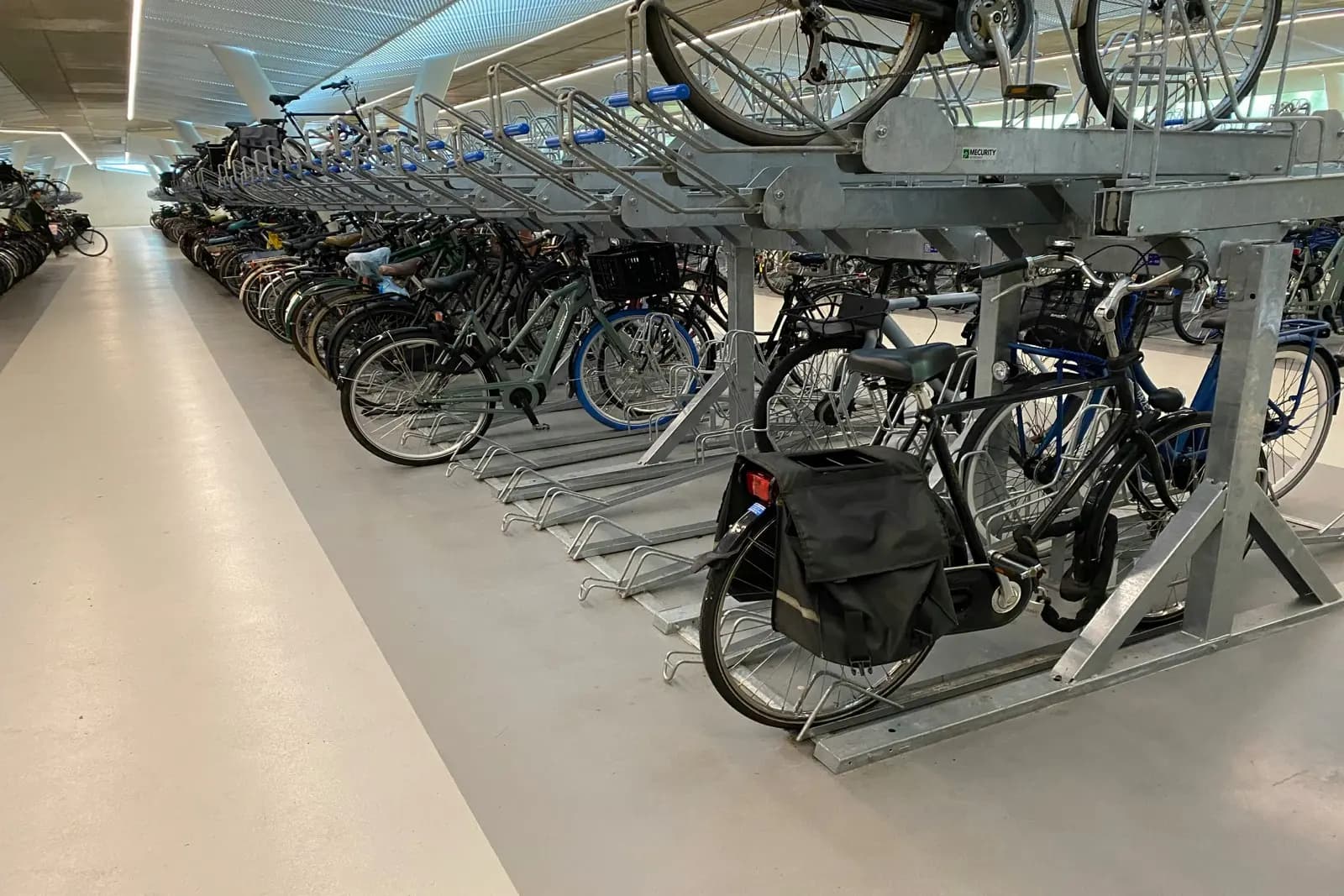
- ✓Match rack type to user duration: inverted-U for visitors, two-tier or vertical for all-day employee parking.
- ✓Verify your municipal bylaw before purchasing — Toronto, Vancouver, and Montréal each enforce different minimum-ratio rules.
- ✓Specify hot-dip galvanized steel for outdoor Canadian conditions; powder-coat over galvanized for branded colour.
- ✓Plan capacity for 5–15% of daily occupancy at office sites, 20–40% at schools, with 20% buffer for growth.
Key Takeaways
- •Match rack type to user duration: inverted-U for visitors, two-tier or vertical for all-day employee parking.
- •Verify your municipal bylaw before purchasing — Toronto, Vancouver, and Montréal each enforce different minimum-ratio rules.
- •Specify hot-dip galvanized steel for outdoor Canadian conditions; powder-coat over galvanized for branded colour.
- •Plan capacity for 5–15% of daily occupancy at office sites, 20–40% at schools, with 20% buffer for growth.
Choosing the right bike rack for your business is an important decision that affects your customers, employees, property value, and compliance with local bylaws. With dozens of bike rack types, materials, and configurations available, it can be overwhelming to know where to start. This guide walks you through the key factors to consider when selecting commercial bike racks for any Canadian business.
Step 1: Understand Your Requirements
Before browsing products, answer these fundamental questions about your bike parking needs:
Who will use the racks? Employees parking all day need different solutions than customers visiting for 30 minutes. Long-term users benefit from covered shelters or indoor bike rooms, while short-term visitors need convenient outdoor racks near your entrance.
How many bikes do you need to accommodate? Count the number of cyclists you expect at peak times. A good rule of thumb is to start with enough spaces for 5-10% of your daily visitors or employees, then plan for growth. Many Canadian cities are seeing cycling rates increase 10-15% annually.
What are your local bylaw requirements? Most major Canadian municipalities now mandate minimum bicycle parking in commercial developments. Toronto requires specific ratios based on building use and floor area. Vancouver has some of the most stringent requirements in North America. Check your municipal zoning bylaw before selecting products to ensure compliance.
Step 2: Choose Your Rack Type
The most common commercial bike rack types are:
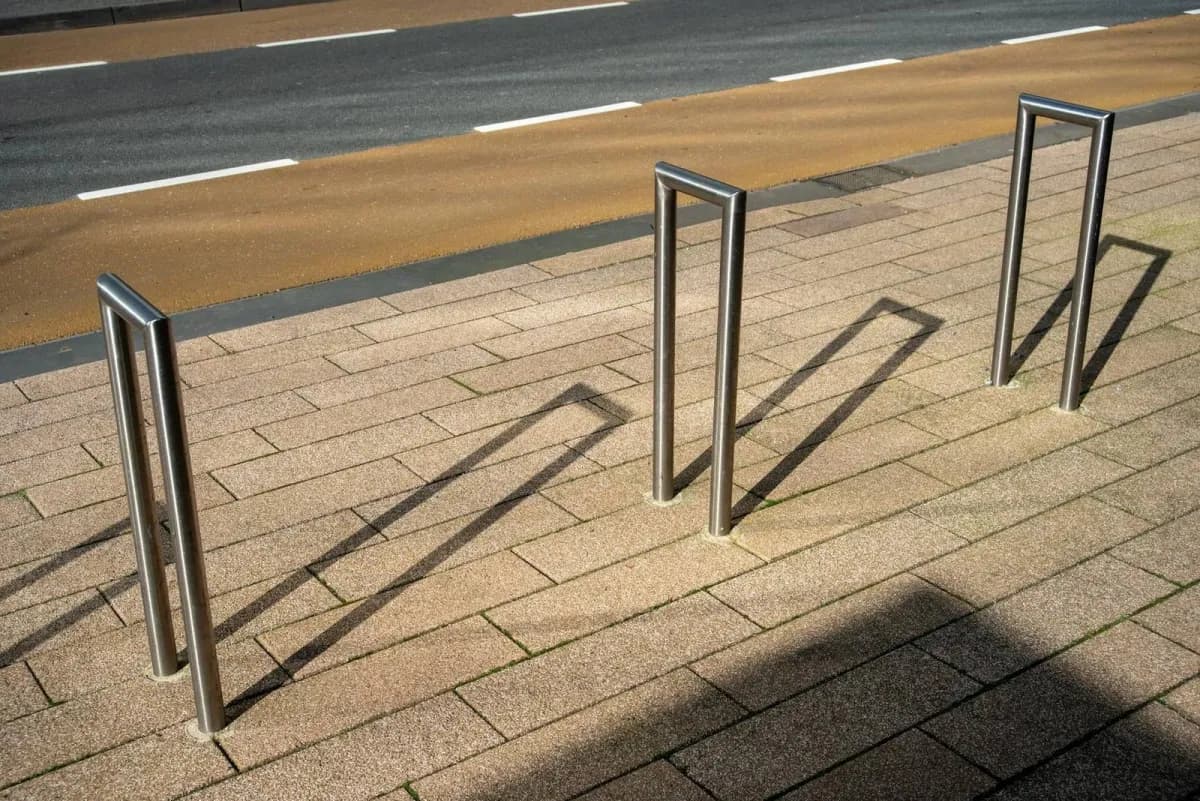
Inverted-U (Staple) Racks — The gold standard for commercial outdoor parking. Each rack holds two bikes with two secure locking points per bike. Simple, durable, and universally recognized by cyclists. Best for: building entrances, retail storefronts, and public spaces.
Wave Racks — Fit more bikes in less linear space than inverted-U racks, but provide only one locking point per bike. Best for: areas where space is tight and moderate security is acceptable.
Post-and-Ring Racks — Clean aesthetic favoured by many Canadian municipalities. One bike per ring with a central locking point. Best for: downtown streetscapes and heritage districts with design guidelines.
Bike Shelters — Covered structures that protect bikes from rain, snow, and UV damage. Essential for employee parking where bikes sit all day. Best for: corporate campuses, transit stations, and institutional buildings.
Bike Lockers — Fully enclosed individual compartments for maximum security. Best for: transit stations, hospitals, and high-theft-risk locations.
Step 3: Select Your Material and Finish
Material choice determines how long your bike rack will last in Canadian conditions:
Hot-Dip Galvanized Steel — The most popular commercial choice. The zinc coating bonds metallurgically with the steel, providing 20+ years of corrosion resistance against road salt, de-icing chemicals, and freeze-thaw cycles. Zero maintenance required. This is the same coating used on highway guardrails across Canada.
304 Stainless Steel — Premium architectural finish that maintains its appearance indefinitely. Naturally corrosion-resistant without any coating. More expensive than galvanized but ideal for high-visibility corporate entrances and heritage districts.
Powder-Coated Steel — Available in any colour for branding purposes, but the coating will chip and peel within 3-5 years of outdoor exposure in Canadian winter conditions. Best reserved for indoor applications or locations with minimal salt exposure.
Step 4: Plan Your Installation
Installation method affects both security and long-term durability:
Surface-mount installations bolt the rack to existing concrete using expansion anchors. This is the fastest and most common method, taking about 30 minutes per rack. Suitable for most commercial applications.
In-ground (embedded) installations set the rack legs directly into fresh concrete. This provides the most permanent, tamper-proof installation but requires new concrete work. Preferred by municipalities and transit agencies for public installations.
Step 5: Consider Accessibility and Spacing
All commercial bike parking in Canada must meet provincial accessibility standards. Key requirements include minimum 900mm clearance between racks for wheelchair passage, minimum 600mm spacing between bike parking spaces, and clear sightlines for safety and security cameras. Your local AODA or equivalent accessibility legislation may have additional requirements.
Getting Started
BikeRacks.ca provides free consultations for commercial bike parking projects anywhere in Canada. Our team will assess your site, recommend the right products and quantities, provide layout drawings for your approval, and coordinate delivery and professional installation. Contact us today for a no-obligation quote.
Common Mistakes to Avoid
When selecting commercial bike racks, property owners commonly make several mistakes that lead to wasted money and poor results:
Buying cheap racks that rust in one winter. Painted or powder-coated racks cost less upfront but need replacement within 3-5 years in Canadian conditions. Galvanized racks cost 20-30% more initially but last 20+ years, making them far more economical over the life of the building.
Choosing wheel-only racks. Racks that hold only the front wheel without supporting the frame are unstable, can damage wheels, and provide poor security because a thief can simply remove the front wheel and steal the rest of the bike. Always choose racks that support the bicycle frame.
Installing too few racks. Starting with 4 racks when you need 12 means cyclists will lock their bikes to fences, handrails, trees, and signposts — creating an unsightly mess and potential accessibility hazard. It is better to overestimate initial demand than to add racks piecemeal.
Poor placement. Bike racks hidden behind the building or far from the entrance will not be used. Cyclists need to see the racks from the street, and the racks need to be on a direct path between the street and the door. Visibility also provides natural security surveillance from passersby.
Budget Planning
Commercial bike rack budgets vary widely depending on the product type and installation method. Basic inverted-U racks cost $200-400 each installed, covering 2 bikes per rack. A typical small commercial installation of 10 bike spaces costs $1,000-2,000 complete. Larger installations with shelters or lockers can range from $5,000 to $50,000 depending on capacity and complexity. BikeRacks.ca provides detailed quotations that break down product, delivery, and installation costs so you can plan your budget accurately.
Frequently Asked Questions
How many bike racks does my Canadian business need?
Start by counting peak daily cyclists and add 20% for growth. Most office buildings target 5–15% of total occupancy at peak; retail destinations target 5–10% of daily visitor counts. Check your municipal bylaw — Vancouver requires 1.25 long-term spaces per residential unit, Toronto requires 0.9, and most cities scale commercial requirements by floor area.
Inverted-U vs wave rack: which is better for commercial use?
Inverted-U is the industry standard. Each U gives two secure locking points per bike (frame + wheel), meets CSA Z321 spacing, and is universally recognized. Wave racks pack more bikes per linear metre but only offer one locking point per bike, so they're acceptable for low-theft areas and tight footprints, not premium installations.
Do I need a building permit for outdoor bike racks?
In most Canadian municipalities, surface-mounted racks on existing concrete do not require a permit, but in-ground installations and bike shelters with footings usually do. Always check with your local building department — we provide engineered stamped drawings to support permit applications when required.
Related Resources
- •Browse our full catalogue of commercial bike racks and bike shelters engineered for Canadian conditions.
- •Explore bike parking solutions by sector: residential, commercial offices, municipal, and education.
- •Local installation in major Canadian cities: Toronto, Vancouver, Montreal, Calgary, Ottawa.
- •See frequently asked questions or contact our team for a free quote in 24 hours.
Frequently Asked Questions
Where can I buy commercial bike racks in Canada?
BikeRacks.ca delivers bike racks across all 10 Canadian provinces and 3 territories. Order online or contact us for a free quote with fast shipping from our Ontario and BC warehouses.
What is the best material for outdoor bike racks in Canada?
Hot-dip galvanized steel is the best choice for outdoor installations in Canada. The zinc coating resists road salt, de-icing chemicals, and freeze-thaw cycles for 20+ years with zero maintenance.
How much do commercial bike racks cost?
Commercial bike rack prices range from $75-$2,500 depending on type, material, and quantity. Basic inverted-U racks start at about $200 installed. Volume discounts available for 10+ units.