Key Takeaways
- ✓Montréal Règlement de zonage 04-047 sets bike parking minimums; ratios vary by arrondissement.
- ✓Ville-Marie, Plateau-Mont-Royal, and Sud-Ouest have higher requirements than outer boroughs.
- ✓Quebec snow load 2.5 kPa; frost depth 1.5 m; freeze-thaw cycles 70+/year — specs above GTA.
- ✓All documentation, signage, and procurement must be in French for Montréal projects.
Key Takeaways
- •Montréal Règlement de zonage 04-047 sets bike parking minimums; ratios vary by arrondissement.
- •Ville-Marie, Plateau-Mont-Royal, and Sud-Ouest have higher requirements than outer boroughs.
- •Quebec snow load 2.5 kPa; frost depth 1.5 m; freeze-thaw cycles 70+/year — specs above GTA.
- •All documentation, signage, and procurement must be in French for Montréal projects.
Montréal's Règlement de zonage 04-047 establishes the bicycle parking requirements that all new residential, commercial, and institutional developments in the City of Montréal must meet. With Montréal's strong cycling culture and large francophone population, compliance with this bylaw is essential for developers working in Quebec's largest city.
This guide explains the bylaw's structure, equipment specifications, and the bilingual procurement and installation considerations specific to Quebec.
Bylaw Structure: Long-Term and Short-Term Categories
Like Toronto and Vancouver, Montréal divides bike parking into two categories:
Stationnement à long terme (Class A) — for residents, employees, and students parking 6+ hours: - Indoor or weather-protected enclosed structure - Secure access restricted to building occupants - Bike supported upright with two-locking-point design - Available 24/7 to occupants
Stationnement à court terme (Class B) — for visitors parking under 2 hours: - Outdoor near principal building entrance - Visible from entrance for security - Open to public during business hours - Inverted-U racks with two-locking-point design
Required Ratios in Montréal
Specific ratios depend on building type and arrondissement (borough), with the central arrondissements (Ville-Marie, Plateau-Mont-Royal, Sud-Ouest) typically having higher requirements than outer boroughs:
Multi-residential: Minimum 1 long-term space per residential unit, with multipliers for studio, 1-bedroom, 2-bedroom+ units
Commercial / office: Spaces per 100 m² of net floor area, varying by use category
Institutional / educational: Higher ratios reflecting student cycling rates
Industrial: Lower ratios reflecting freight-heavy use
The 04-047 bylaw text and current ratios should be verified against the most recent version on the City of Montréal website. Specific arrondissements may have additional or higher requirements through borough-level bylaw amendments.
Equipment Specifications
Montréal's bylaw aligns with industry standards (similar to APBP Class III):
- •Bicycle frame and at least one wheel must be lockable to the rack
- •Rack must support bicycle upright without kickstand
- •Rack must be securely anchored to floor, wall, or ceiling
- •Spacing must allow accessible use with adequate horizontal clearance
Equipment that meets these criteria for stationnement à long terme:
- •Supports verticaux muraux (wall-mounted vertical hooks) with rubber-coated rim contact
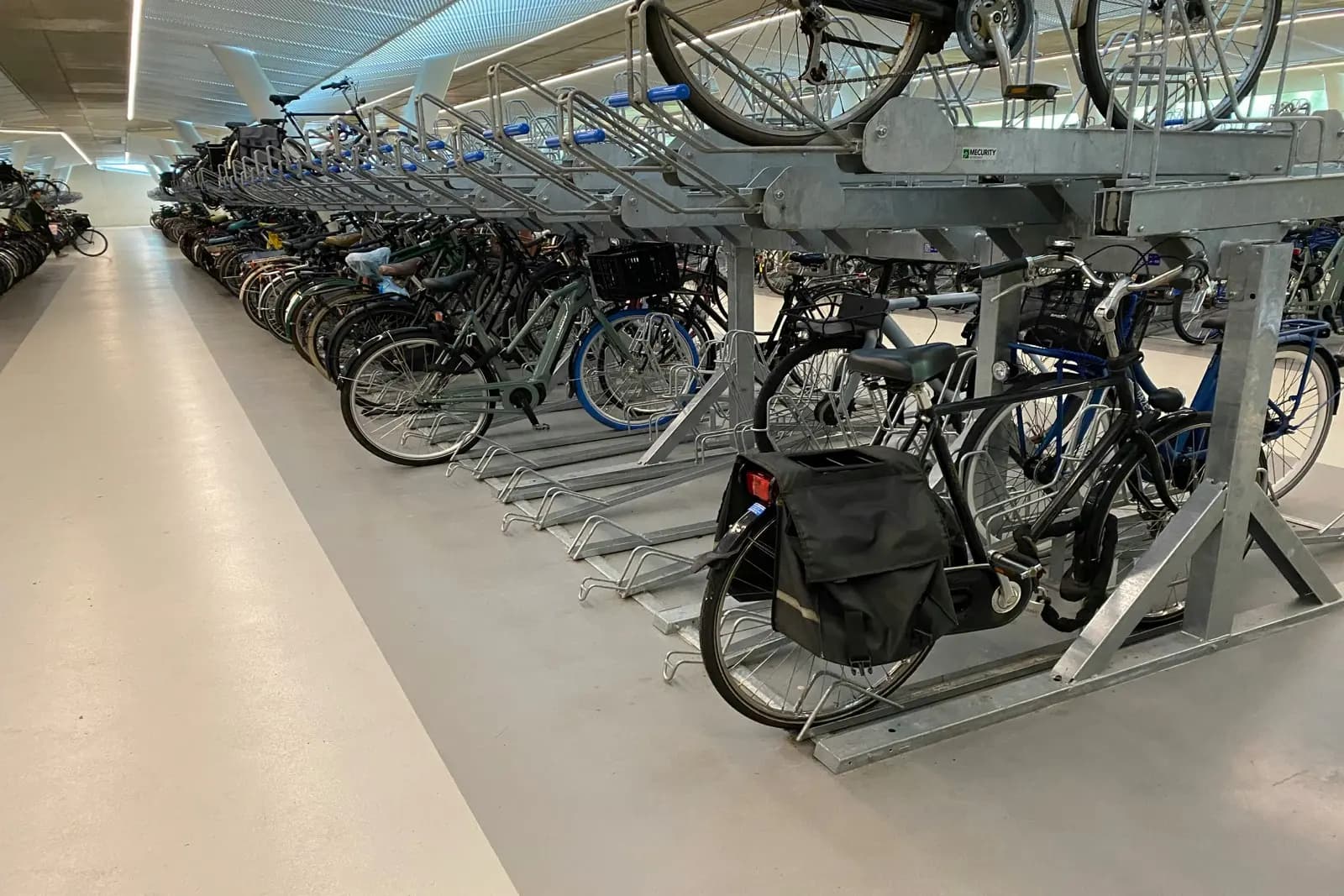
- •Supports à deux niveaux (two-tier rack systems) with gas-strut assisted upper tier
- •Supports verticaux sur pied (floor-standing vertical stands) with lift assist
- •Casiers à vélos (individual bike lockers) for premium tier
- •Cages à vélos (fenced bike cages) within underground parking or service yards
For stationnement à court terme:
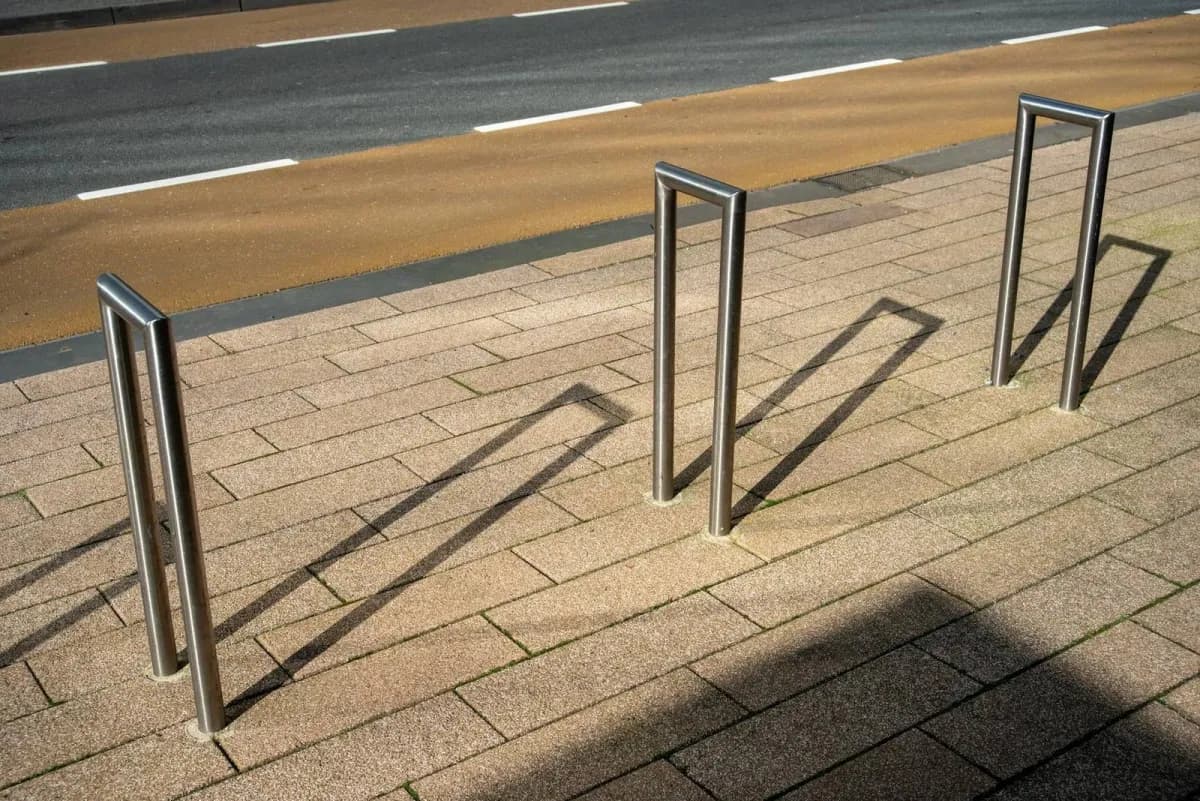
- •Supports en U inversé (inverted-U racks) — industry standard
- •Supports poteau-anneau (post-and-ring racks) — common in Montréal streetscapes
- •Bollards à vélos for architectural integration
Climate Considerations for Montréal
Montréal experiences distinct climate challenges that affect bike parking equipment selection:
Snow loads — Greater Montréal area requires 2.5 kPa snow load on bike shelters and covered structures. Northern arrondissements like Saint-Laurent and Montréal-Nord may require higher loads due to local accumulation patterns.
Freeze-thaw cycles — Montréal experiences 70+ freeze-thaw cycles per year, second only to Quebec City among major Canadian cities. This destroys painted finishes within 2-3 years; hot-dip galvanized steel is the only durable specification.
Calcium chloride and salt — Quebec uses heavy de-icing in urban areas. Galvanized steel resists this; powder-coated paint over galvanized base provides aesthetic colour with same corrosion protection.
Wind loads — St. Lawrence corridor experiences higher wind loads than inland Quebec. Coastal-facing exposures require engineered anchorage.
Bilingual Procurement and Documentation
Montréal projects require French-language documentation for permit submissions, contractor coordination, and inspection. A qualified bike rack supplier should provide:
- •Fiches techniques (technical specification sheets) in French
- •Plans d'installation (installation drawings) in French with metric dimensions
- •Soumissions (bids) in French with Canadian dollar pricing including TPS + TVQ
- •Rapports de conformité (conformity reports) for permit closeout
- •Service après-vente (after-sales support) in French
- •Bilingual project management for coordination with municipal inspectors
For provincially-funded or institutional projects (universities, CEGEPs, hospital networks), all RFP responses must be in French.
Bike Room Design for Quebec
For multi-residential bike rooms in Montréal:
- •Floor surface: Vinyl, epoxy, or sealed concrete with floor drains for snow runoff
- •Ceiling height: 2.4 m minimum (wall hooks), 3.0 m (two-tier racks)
- •Aisle width: 1.2 m minimum between rack rows
- •Lighting: 150 lux minimum per CSA Z321, motion-activated
- •Climate: Heated to 5-15 °C with 30-60% humidity
- •Ventilation: 6 air changes per hour minimum
- •Security: Card-access entry, CCTV with 30-day retention, emergency button
- •Accessibility: Accessible path of travel from main entrance per provincial accessibility standard
Outdoor Class B in Montréal Streetscape
Montréal has invested heavily in stationnement vélo court terme dans la rue (on-street short-term bike parking) particularly in Plateau-Mont-Royal, Mile End, and Vieux-Montréal. Common configurations:
- •Supports poteau-anneau integrated with pedestrian wayfinding
- •Corrals à vélos in retail districts, sometimes converted from on-street parking spaces
- •Supports en U inversé in standardized clusters every 50-100 m on commercial streets
Material standard: hot-dip galvanized steel with optional powder-coat finish in city-specified colours (typically dark grey or matte black).
Vieux-Montréal and Heritage Districts
Heritage zones including Vieux-Montréal require architectural sensitivity in bike parking specifications. 304 stainless steel, Corten weathering steel, or wood-clad steel racks are common substitutions for standard galvanized in these areas. All installations must respect heritage signage, sightlines, and pavement materials.
The Permit Process
For new Montréal developments:
1. Calculer le stationnement vélo requis based on building type, area, and arrondissement 2. Spécifier l'équipement meeting bylaw requirements 3. Préparer plans d'aménagement showing rack positions and accessibility 4. Soumettre demande de permis including bicycle parking section 5. Répondre commentaires from Service de l'urbanisme review 6. Installer selon plans approuvés with documented inspection 7. Inspection préoccupation confirms compliance
Working With a Bilingual Supplier
For Montréal and Quebec projects, working with a bilingual French/English supplier is essential. A qualified supplier provides:
- •Bilingual sales service for technical consultation
- •French-language quotes and bids
- •French technical documentation for permit submissions
- •Bilingual installation crews for site coordination
- •French after-sales service for warranty claims and parts
BikeRacks.ca offers full bilingual service for Montréal, Québec City, Laval, Gatineau, Longueuil, Sherbrooke, Trois-Rivières, and surrounding regions, with French-language documentation, bilingual installation crews, and Quebec-bylaw-compliant equipment specifications. Free site assessments and bilingual quotes are available for any Quebec project.
Frequently Asked Questions
Where do I find the exact ratios for my Montréal arrondissement?
Each arrondissement maintains its own zoning by-law amendments on top of 04-047. Check the Ville de Montréal website under Service de l'urbanisme for your borough's current minimums by building type.
Do French-language stamped drawings cost more for Quebec projects?
Slightly — typically 5–10% premium for fully bilingual engineering documentation. BikeRacks.ca includes French-language fiches techniques and installation plans at standard rates for any Quebec project.
What is "stationnement à long terme" in Montréal?
It is the local term for Class A bike parking — indoor or weather-protected, secure, residents/employees only, available 24/7. Equivalent to Toronto's long-term and Vancouver's Class A.
Related Resources
- •Browse our full catalogue of commercial bike racks and bike shelters engineered for Canadian conditions.
- •Explore bike parking solutions by sector: residential, commercial offices, municipal, and education.
- •Local installation in major Canadian cities: Toronto, Vancouver, Montreal, Calgary, Ottawa.
- •See frequently asked questions or contact our team for a free quote in 24 hours.
Frequently Asked Questions
Where can I buy commercial bike racks in Canada?
BikeRacks.ca delivers bike racks across all 10 Canadian provinces and 3 territories. Order online or contact us for a free quote with fast shipping from our Ontario and BC warehouses.
What is the best material for outdoor bike racks in Canada?
Hot-dip galvanized steel is the best choice for outdoor installations in Canada. The zinc coating resists road salt, de-icing chemicals, and freeze-thaw cycles for 20+ years with zero maintenance.
How much do commercial bike racks cost?
Commercial bike rack prices range from $75-$2,500 depending on type, material, and quantity. Basic inverted-U racks start at about $200 installed. Volume discounts available for 10+ units.