Key Takeaways
- ✓Vancouver requires 1.25 Class A spaces per residential unit — the highest in Canada.
- ✓Class A must be secure, weather-protected, accessible 24/7 to occupants only.
- ✓Coastal salt air mandates stainless 304 or hot-dip galvanized + powder-coat finish.
- ✓Frost depth = 0.6 m (mildest in major Canadian cities); snow load 1.5 kPa.
Key Takeaways
- •Vancouver requires 1.25 Class A spaces per residential unit — the highest in Canada.
- •Class A must be secure, weather-protected, accessible 24/7 to occupants only.
- •Coastal salt air mandates stainless 304 or hot-dip galvanized + powder-coat finish.
- •Frost depth = 0.6 m (mildest in major Canadian cities); snow load 1.5 kPa.
Vancouver leads Canadian municipalities in residential bike parking requirements with a 1.25 Class A space per dwelling unit ratio that significantly exceeds the 0.9 ratio in Toronto and equivalent ratios in most other major Canadian cities. For developers building in Vancouver, this higher ratio fundamentally affects bike room sizing, equipment selection, and permit timeline.
This guide explains what the 1.25 ratio means in practice, what equipment qualifies as Class A, and how to design compliant bike rooms.
What Class A Bike Parking Means in Vancouver
Vancouver's parking bylaw distinguishes between Class A and Class B bicycle parking, similar to other major Canadian municipalities but with stricter quality standards for Class A.
Class A bike parking in Vancouver must:
- •Be located indoors or within a fully enclosed and weather-protected structure
- •Have controlled access restricted to building occupants (not public)
- •Be secure with the bike supported upright and locked to the rack
- •Be accessible to building residents at any hour
- •Support bicycle locking with frame plus at least one wheel
- •Meet provincial and municipal accessibility standards
Class B bike parking is short-term, outdoor, public-facing parking near building entrances. Vancouver's Class B requirements are similar to other municipalities (typically smaller ratios, inverted-U racks, near principal pedestrian entrance).
The 1.25 ratio applies specifically to Class A long-term parking. Class B short-term parking is required separately at smaller ratios depending on building use.
Why 1.25 Per Unit?
Vancouver's high cycling mode share — among the highest in North America — drove the regulatory choice to specify more bike parking than dwelling units in new developments. The reasoning:
- •Households often own multiple bikes (parents plus children's bikes)
- •Visitors and short-term guests need bike storage too
- •Future-proofing for cycling growth: today's mode share could grow further by mid-century
- •Multi-residential cycling is constrained by lack of bike parking; the City wants to remove that constraint
Practically, a 100-unit residential development in Vancouver requires 125 Class A bike parking spaces plus the additional Class B short-term parking calculated separately. This is roughly double what the same development would require in Toronto under By-Law 569-2013's 0.9 ratio.
Equipment That Qualifies as Class A
Not all bike racks qualify as Vancouver Class A bike parking. The minimum specifications:
Indoor bike rooms with controlled access, equipped with one or more of:
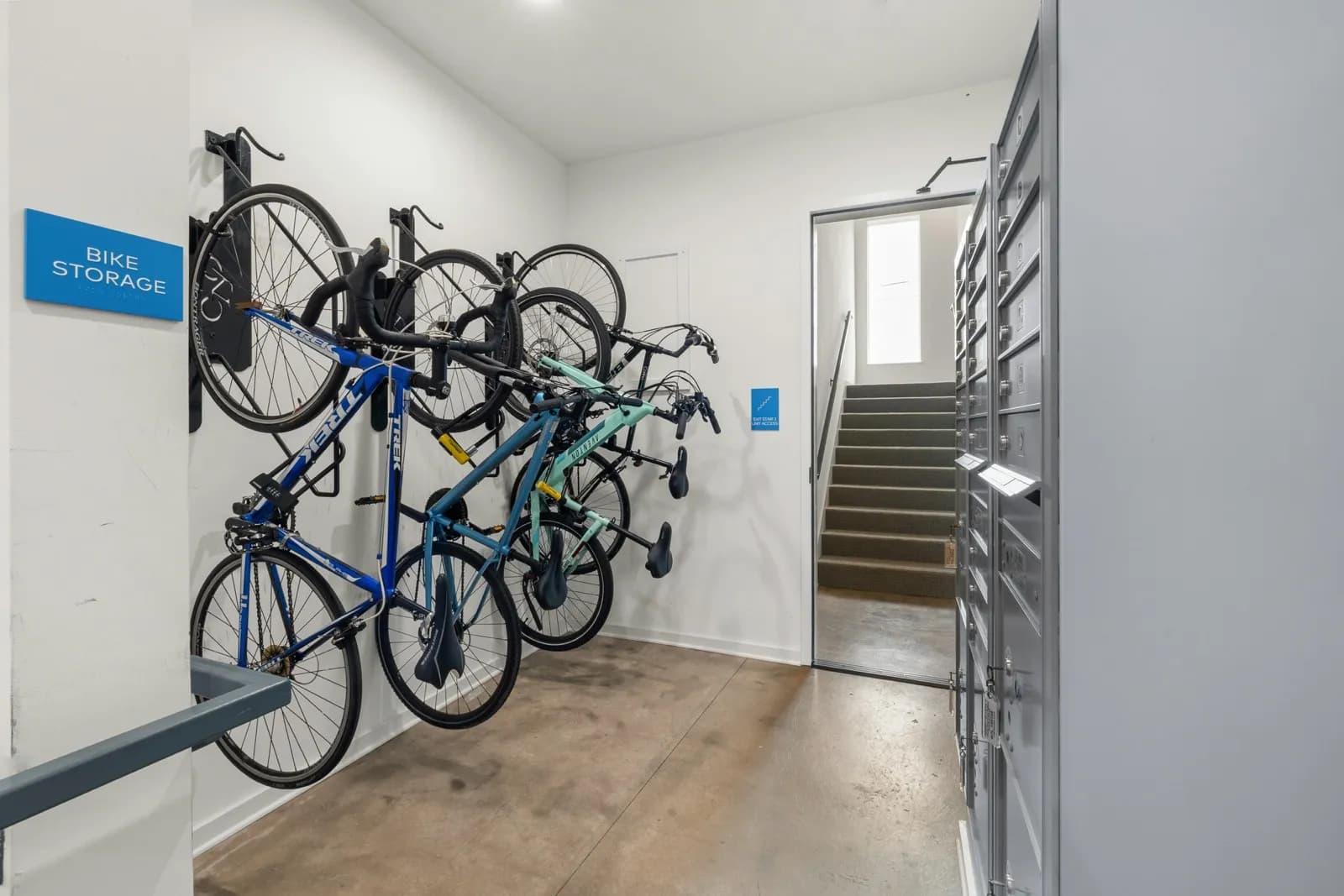
- •Wall-mounted vertical hooks — single-bike vertical hangers with rubber-coated rim contact, mounted into wall studs or concrete with engineered anchorage
- •Floor-mounted vertical bike stands with optional gas-strut lift assist
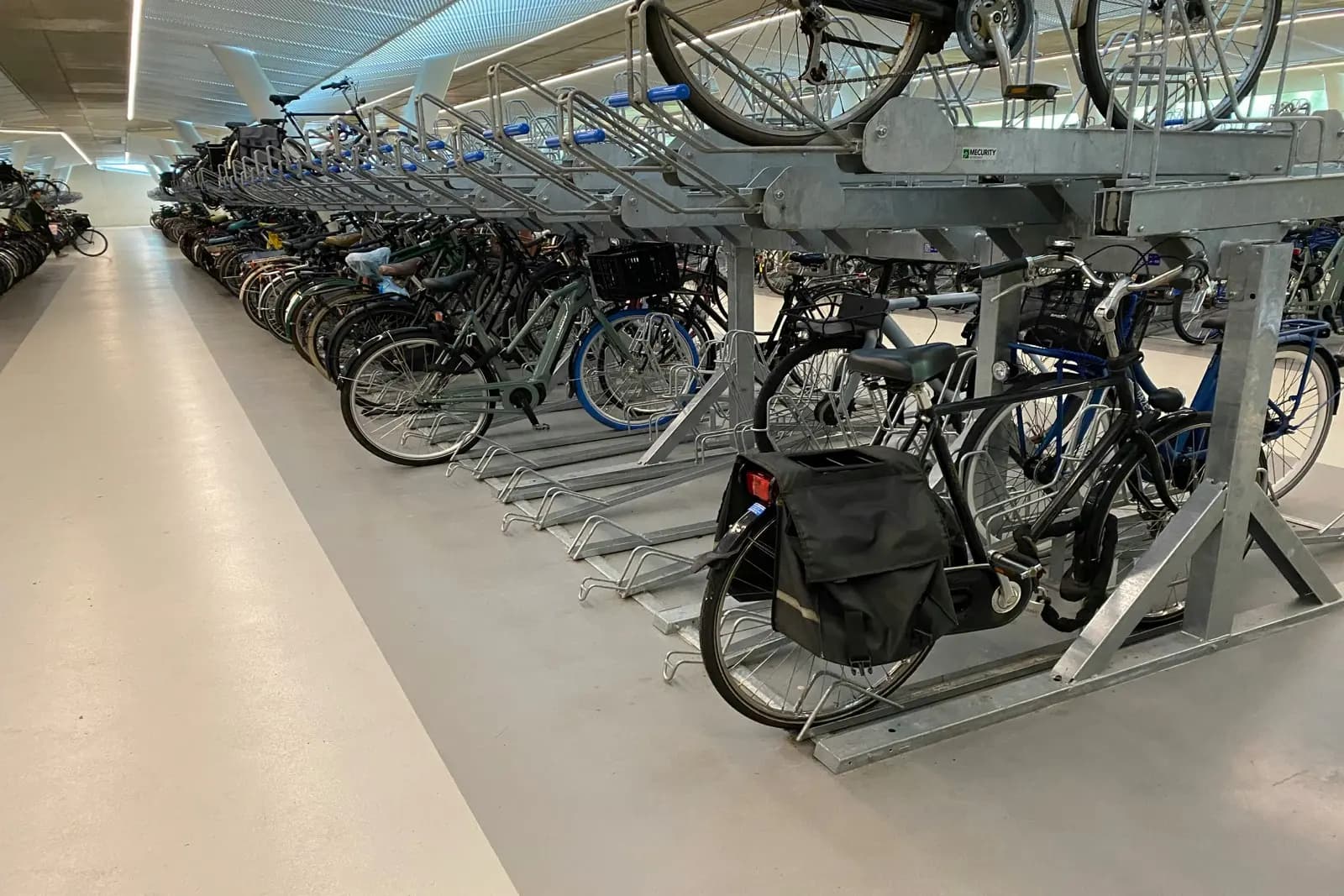
- •Two-tier rack systems with gas-strut assisted upper tier, suitable for high-density bike rooms
- •Floor-standing horizontal racks when wall space isn't available
- •Individual bike lockers for premium-tier bike parking (counts as Class A but typically supplements rather than replaces rack-based parking)
What does NOT qualify as Class A:
- •Outdoor inverted-U racks (these are Class B short-term)
- •Wave racks lacking two locking points
- •Bike racks in shared garages without controlled access
- •Racks placed in residential lobbies, hallways, or common rooms without dedicated security
- •Racks accessible to non-occupants
Bike Room Sizing for the 1.25 Ratio
For a 100-unit residential development requiring 125 Class A spaces, room sizing depends on equipment selection:
Wall-mounted vertical hooks (highest density per wall): - 8 hooks per 3 m of wall section (alternating high/low) - 125 hooks ÷ 8 hooks per 3 m = 47 m of wall length needed
Two-tier racks (highest absolute density): - Each two-tier unit holds 4-8 bikes (depending on configuration) - 125 bikes ÷ 6 bikes per unit = 21 two-tier units - Footprint: 21 × 1.0 m × 0.6 m = 12.6 m² for racks alone, plus 1.5 m aisles between rows - Total room: roughly 5 m × 10 m (50 m²)
Mixed equipment (typical Vancouver bike room): - 60% wall-mounted vertical hooks for low-effort daily users - 30% two-tier racks for power users with lighter bikes - 10% bike lockers for premium tier (often charge-by-month)
Total bike room area for 125 spaces: typically 80-120 m² depending on equipment mix and ceiling height.
Bike Room Design Standards
For Vancouver Class A bike parking installations:
Floor surface: Vinyl, epoxy, or sealed concrete; slope 1-2% to floor drains; no carpet (impossible to clean melted snow)
Ceiling height: Minimum 2.4 m for wall-mounted hooks; minimum 3.0 m for two-tier racks (upper tier swing clearance)
Aisle width: Minimum 1.2 m between rack rows; 1.5 m for two-tier rack rows
Lighting: Minimum 150 lux per CSA Z321; motion-activated for energy efficiency
Climate control: Heated to 5-15 °C in winter; 30-60% relative humidity to prevent corrosion of stored bikes
Ventilation: 6 air changes per hour minimum; manages moisture from snow-covered bikes brought in during winter
Drainage: Floor drains in entry zone; slope to drain in winter snow runoff path
Security: Card-access entry restricted to building occupants; CCTV with 30-day recording minimum; emergency call button at the bike room interior
Accessibility: Accessible path of travel from main building entrance; adequate maneuvering space for bike + rider; lower hooks (1.4-1.5 m) for shorter users mixed with standard 1.6-1.8 m hooks
E-Bike Considerations
E-bikes are increasingly common in Vancouver — the city's hilly geography makes pedal-assist particularly valuable. For Class A bike parking serving e-bike users:
- •Reinforced wall hooks rated for 30-40 kg (versus standard 20-25 kg)
- •Lower hook heights (1.4-1.5 m) so users don't lift heavy e-bikes overhead
- •Optional charging outlets at one outlet per 2-3 racks (GFCI-protected, IP44 rated for indoor)
- •Cargo e-bike accommodation — provide some floor-standing or expanded-locker spaces for longer-wheelbase cargo e-bikes
Recent Vancouver bylaw amendments increasingly require e-bike-capable Class A bike parking with charging infrastructure in new developments.
The Permit Process
For new Vancouver residential developments:
1. Calculate required Class A spaces = total dwelling units × 1.25 2. Calculate required Class B spaces based on building use ratios 3. Specify equipment that meets Class A criteria 4. Prepare bike room layout drawings showing rack positions, accessibility, and emergency egress 5. Submit development permit application including bicycle parking section 6. Address comments from City of Vancouver review staff 7. Install per approved drawings with documented post-installation inspection 8. Pre-occupancy inspection confirms compliance
Working With a Qualified Vancouver Supplier
A bike rack supplier with Vancouver experience offers:
- •Class A compliance-confirmed equipment specifications
- •Layout drawings sized for the 1.25 ratio
- •Installation crews familiar with Vancouver site conditions
- •Post-installation inspection reports for permit closeout
- •Direct response to City of Vancouver review comments
- •Coordination with mechanical/electrical contractors for ventilation, drainage, and charging integration
BikeRacks.ca supplies and installs Class A-compliant bike parking systems across the Greater Vancouver Regional District including Vancouver, Surrey, Burnaby, Victoria, and Kelowna. Free site assessments and Vancouver-bylaw-compliant equipment recommendations are available for any project.
The 1.25 ratio represents a significant capital cost compared to lower-ratio jurisdictions — but properly executed, it delivers a long-lasting cycling amenity that increases tenant attraction and supports Vancouver's urban mobility goals.
Frequently Asked Questions
Why is Vancouver's 1.25 ratio so much higher than other cities?
Vancouver has the highest cycling mode share of any major Canadian city (around 7% of commutes) and has prioritized cycling infrastructure since the 2010 Olympics. The 1.25 ratio anticipates continued growth toward European levels (10–20%) and ensures new construction will not become a parking constraint.
Can underground parking garage spaces count as Class A?
Yes — if the garage is weather-protected, accessible only to building occupants (key/fob entry), and equipped with proper bike racks (not just leaning posts). Most new Vancouver residential towers convert dedicated underground rooms or partition off bike cages in shared parking levels.
Does Vancouver require electric bike (e-bike) charging at bike parking?
Increasingly yes for new construction. The City's green-building requirements include e-bike charging outlets at a percentage of Class A spaces. Specifications vary by zone; consult the current Vancouver Building Bylaw and Green Buildings Policy.
Related Resources
- •Browse our full catalogue of commercial bike racks and bike shelters engineered for Canadian conditions.
- •Explore bike parking solutions by sector: residential, commercial offices, municipal, and education.
- •Local installation in major Canadian cities: Toronto, Vancouver, Montreal, Calgary, Ottawa.
- •See frequently asked questions or contact our team for a free quote in 24 hours.
Frequently Asked Questions
Where can I buy commercial bike racks in Canada?
BikeRacks.ca delivers bike racks across all 10 Canadian provinces and 3 territories. Order online or contact us for a free quote with fast shipping from our Ontario and BC warehouses.
What is the best material for outdoor bike racks in Canada?
Hot-dip galvanized steel is the best choice for outdoor installations in Canada. The zinc coating resists road salt, de-icing chemicals, and freeze-thaw cycles for 20+ years with zero maintenance.
How much do commercial bike racks cost?
Commercial bike rack prices range from $75-$2,500 depending on type, material, and quantity. Basic inverted-U racks start at about $200 installed. Volume discounts available for 10+ units.