Key Takeaways
- ✓Toronto Bylaw 569-2013 requires 0.9 long-term spaces per residential unit plus visitor parking at most building types.
- ✓Class A (long-term) must be indoor or weather-protected with secure occupant-only access.
- ✓Class B (visitor) must be outdoor, near principal entrance, visible with inverted-U racks.
- ✓GTA snow load = 1.5–2.0 kPa; frost depth = 1.2 m for in-ground installs.
Key Takeaways
- •Toronto Bylaw 569-2013 requires 0.9 long-term spaces per residential unit plus visitor parking at most building types.
- •Class A (long-term) must be indoor or weather-protected with secure occupant-only access.
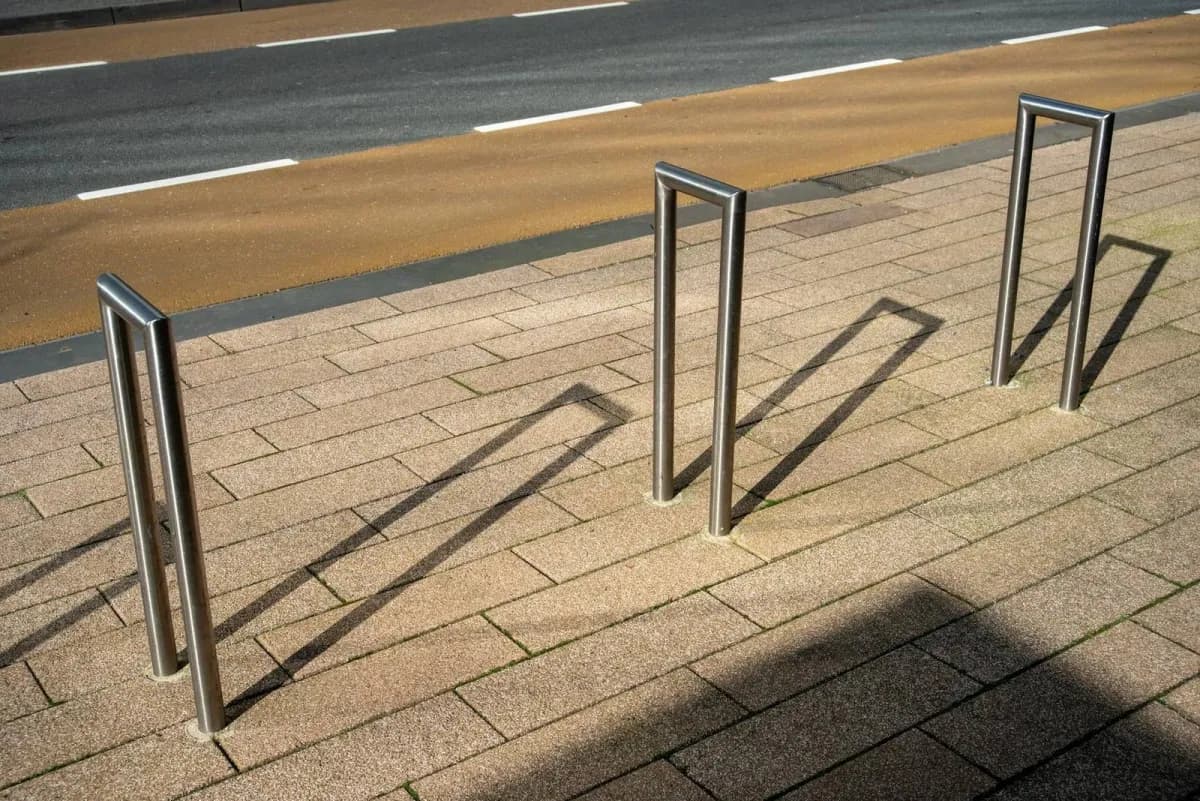
- •Class B (visitor) must be outdoor, near principal entrance, visible with inverted-U racks.
- •GTA snow load = 1.5–2.0 kPa; frost depth = 1.2 m for in-ground installs.
Toronto Zoning By-Law 569-2013 establishes the bicycle parking minimums that all new developments in the City of Toronto must meet to receive building permits and occupancy approval. For developers, architects, and property managers working in Toronto, understanding the bylaw's distinction between long-term and short-term spaces, the per-unit and per-square-metre ratios, and the equipment requirements is essential to avoiding permit delays and reinspection costs.
This guide breaks down the practical compliance requirements and how to specify equipment that meets them.
Two Categories: Long-Term and Short-Term
Toronto's bylaw divides bike parking into two distinct categories with different design and capacity requirements:
Long-term bicycle parking is intended for residents, employees, and students who park bicycles for 6 hours or more. It must be:
- •Located indoors or in a fully enclosed weather-protected structure
- •Secure and accessible only to building occupants (not the general public)
- •Equipped with bike racks that support the bike upright and allow at least one wheel and the frame to be locked
- •Provided at the rate specified in the bylaw based on building use and floor area
Short-term bicycle parking is intended for visitors, customers, and guests who park bicycles for under 2 hours. It must be:
- •Located outdoors near the principal pedestrian entrance
- •Visible from the entrance for safety and security
- •Open to the public during business hours
- •Equipped with bike racks meeting the same locking standards
- •Provided at smaller ratios than long-term parking
Bicycle Parking Ratios in Toronto
The exact ratios depend on building type, but key benchmarks include:
Residential (apartment, condominium): - Long-term: 0.9 spaces per dwelling unit - Short-term: 0.1 spaces per dwelling unit (minimum 6 spaces per building)
Office: - Long-term: 0.13 spaces per 100 m² of net floor area - Short-term: 0.25 spaces per 100 m² of net floor area (minimum 6 spaces)
Retail: - Long-term: 0.13 spaces per 100 m² of net floor area - Short-term: 0.25 spaces per 100 m² of net floor area (minimum 6 spaces)
Institutional (schools, post-secondary): - Long-term: 0.20 spaces per 100 m² of net floor area - Short-term: 0.13 spaces per 100 m²
Industrial: - Long-term: 0.13 spaces per 100 m² - Short-term: 0.05 spaces per 100 m² (minimum 6 spaces)
The bylaw text and current ratios should be verified against the most recent version of By-Law 569-2013 on the City of Toronto website, as ratios are periodically updated.
Equipment Standards
While the bylaw doesn't specify exact rack models, it does require that bicycle parking equipment:
- •Allow the bike to be supported upright without using the kickstand
- •Permit the bicycle frame and at least one wheel to be locked to the rack with a U-lock or chain
- •Be securely anchored to the floor, wall, or ceiling so the rack itself cannot be removed
- •Be spaced for accessible use, with minimum 600 mm horizontal clearance between bicycles when parked
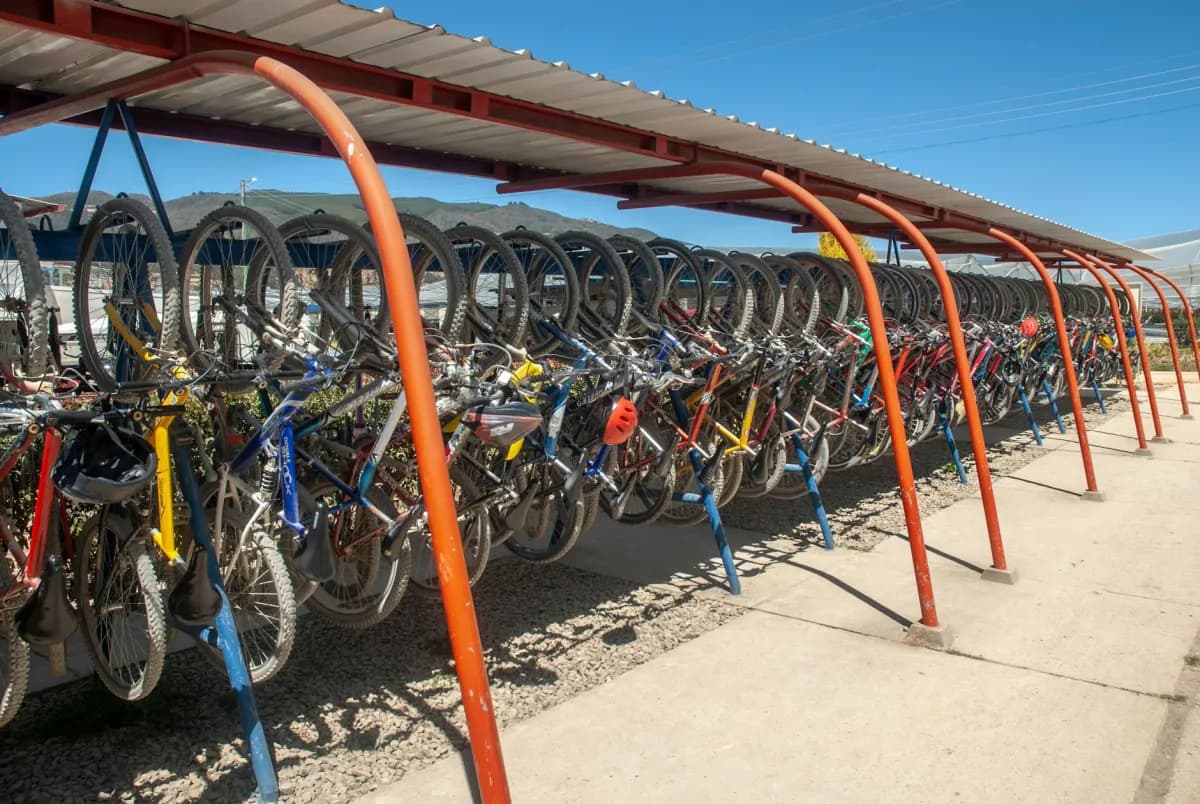
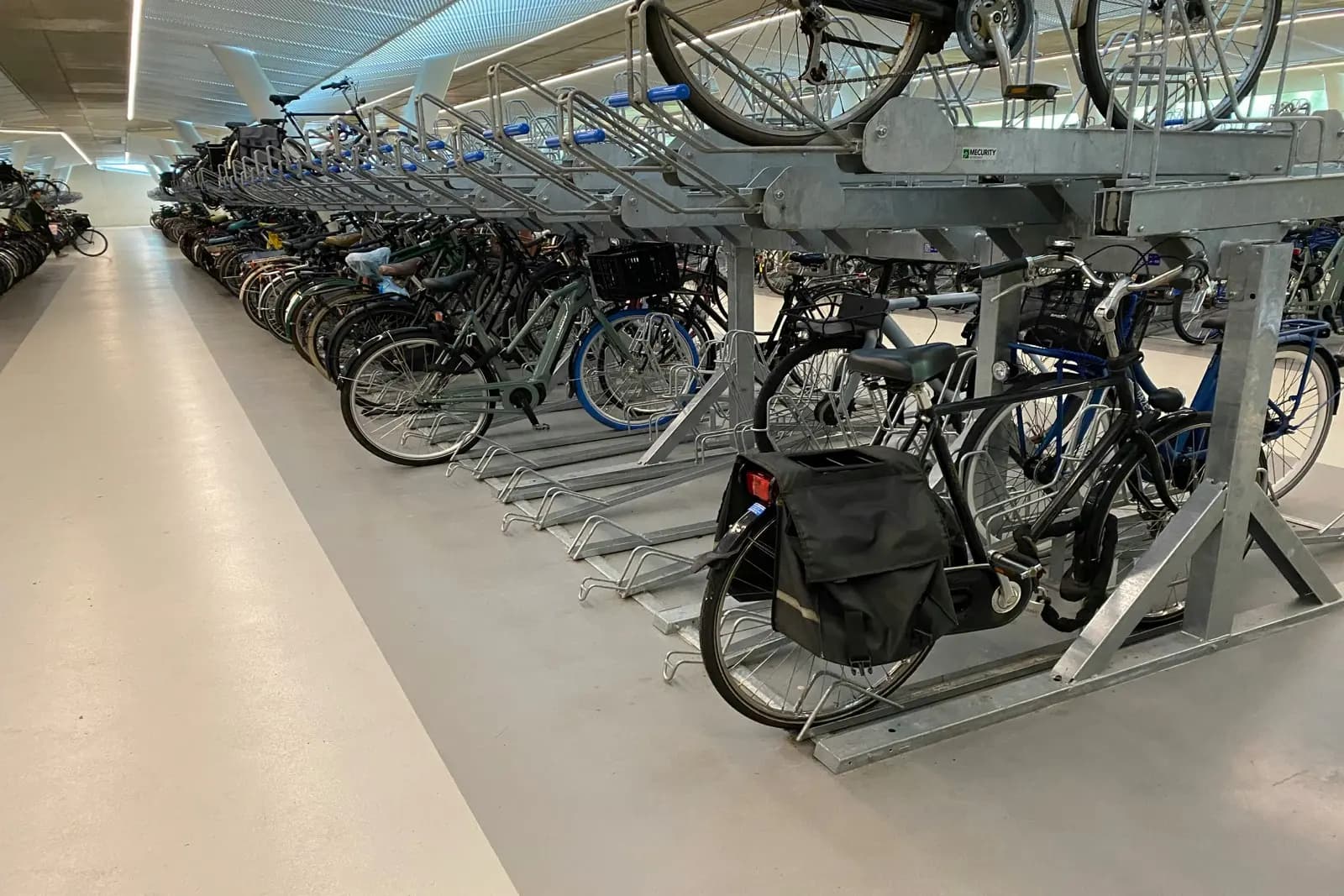
In practice, this means APBP Class III rack designs — most commonly inverted-U racks for outdoor short-term parking and wall-mounted vertical hooks, two-tier racks, or bike lockers for indoor long-term parking. Wave racks are sometimes accepted but only support one locking point per bike (frame only), which is less compliant with the spirit of the bylaw.
Bike Room Design for Long-Term Parking
For multi-residential developments meeting the 0.9 spaces per unit requirement, the bike room design must accommodate the calculated number of spaces with proper rack layout, accessibility, and ventilation. Key design parameters:
Floor space per bike: - Wall-mounted vertical hooks: 0.6 m² per bike (highest density on wall) - Two-tier racks: 0.5 m² lower + 0.5 m² upper = 0.25 m² effective per bike - Floor-standing horizontal racks: 1.2 m² per bike (least dense) - Bike lockers: 1.5 m² per bike (most space, maximum security)
Ceiling height: - Minimum 2.4 m for wall hooks - Minimum 3.0 m for two-tier racks (allow upper-tier swing)
Aisle width: - Minimum 1.2 m between rack rows - 1.5 m if two-tier racks are specified
Lighting: Minimum 150 lux per CSA Z321 bicycle parking standard, motion-activated for energy efficiency
Ventilation: Minimum 6 air changes per hour to manage moisture from snow-covered bikes brought in during winter
Floor surface: Vinyl, epoxy, or sealed concrete (avoid carpet); slope 1-2% to floor drains
Security: Card-access entry restricted to building occupants, CCTV with minimum 30-day recording retention, emergency call button
Short-Term Outdoor Parking Design
For visitor short-term parking near the principal entrance:
- •Inverted-U racks spaced 900 mm centre-to-centre
- •Surface-mount or in-ground installation depending on surface type
- •Visibility from entrance for security and CPTED compliance
- •Lighting minimum 20 lux at the rack surface
- •Pavement ideally concrete (more durable than asphalt for kickstand pressure)
- •Drainage slope 1-2% away from racks to prevent ice formation
The Permit Process
For new developments and major renovations in Toronto:
1. Calculate required bike parking based on building type and area 2. Specify equipment meeting bylaw requirements 3. Prepare layout drawings showing rack positions, spacing, and accessibility paths 4. Submit for site plan approval including bicycle parking documentation 5. Address comments from City of Toronto Cycling Unit on the bicycle parking submission 6. Install per approved drawings with documented post-installation inspection 7. Pre-occupancy inspection confirms bicycle parking is installed and accessible
Common bylaw submission errors that cause permit delays:
- •Specifying wave racks where two-locking-point compliance is implied
- •Insufficient indoor bike room ceiling height for two-tier racks
- •Missing accessible path of travel to the bike room
- •Bike room too far from the principal building entrance
- •Short-term parking not visible from the entrance
- •Ratio calculation errors (using the wrong building type multiplier)
Working With a Qualified Supplier
A bike rack supplier with Toronto bylaw experience can save significant project time by providing:
- •Compliance-confirmed equipment specifications
- •Layout drawings sized to bylaw ratios
- •Installation crews familiar with Toronto site conditions
- •Post-installation inspection reports for the pre-occupancy permit closeout
- •Direct response to City of Toronto Cycling Unit submission comments
BikeRacks.ca has supplied and installed bike parking for Toronto residential, commercial, institutional, and municipal projects with full Toronto Zoning By-Law 569-2013 compliance documentation. Free site assessments and bylaw-compliant equipment recommendations are available for any Toronto project.
For the most current bylaw text and ratios, consult the official City of Toronto Zoning By-Law page or contact the Toronto Cycling Unit directly. This guide is intended as a practical compliance overview, not legal advice; specific project compliance should always be verified against the current bylaw and reviewed by qualified design professionals.
Frequently Asked Questions
What is the Class A ratio under Toronto Bylaw 569-2013?
For residential: 0.9 long-term spaces per dwelling unit. For office: spaces per 100 m² net floor area, varying by building type. Mixed-use buildings combine ratios across their residential, commercial, and institutional portions. Always verify with current City of Toronto Zoning By-law.
Where can I find the exact bicycle parking section in Bylaw 569-2013?
The bicycle parking requirements are in Chapter 200 of the by-law, under the zoning use-specific tables. Each land use has its own minimum bicycle parking calculation. The City of Toronto provides interactive zoning tools online to verify your specific property.
Are heated bike rooms required for Class A in Toronto?
Not strictly required, but recommended. Toronto winters average -6°C with 130 cm annual snowfall; heated bike rooms (5–15°C, 30–60% humidity) preserve bike condition, prevent freezing of locks and gears, and meet "occupant amenity" standards for high-end residential.
Related Resources
- •Browse our full catalogue of commercial bike racks and bike shelters engineered for Canadian conditions.
- •Explore bike parking solutions by sector: residential, commercial offices, municipal, and education.
- •Local installation in major Canadian cities: Toronto, Vancouver, Montreal, Calgary, Ottawa.
- •See frequently asked questions or contact our team for a free quote in 24 hours.
Frequently Asked Questions
Where can I buy commercial bike racks in Canada?
BikeRacks.ca delivers bike racks across all 10 Canadian provinces and 3 territories. Order online or contact us for a free quote with fast shipping from our Ontario and BC warehouses.
What is the best material for outdoor bike racks in Canada?
Hot-dip galvanized steel is the best choice for outdoor installations in Canada. The zinc coating resists road salt, de-icing chemicals, and freeze-thaw cycles for 20+ years with zero maintenance.
How much do commercial bike racks cost?
Commercial bike rack prices range from $75-$2,500 depending on type, material, and quantity. Basic inverted-U racks start at about $200 installed. Volume discounts available for 10+ units.