Key Takeaways
- ✓Class A bike rooms need secure entry (card/fob), CCTV, lighting (150 lux min), and occupant-only access.
- ✓Recommended rack mix: vertical hooks or two-tier systems for max density (0.25–0.6 m² per bike).
- ✓Heat to 5–15°C with 30–60% humidity; 6 air changes/hour; floor drains for snow runoff.
- ✓Aisle width 1.2 m minimum; ceiling 2.4 m for hooks, 3.0 m for two-tier.
Key Takeaways
- •Class A bike rooms need secure entry (card/fob), CCTV, lighting (150 lux min), and occupant-only access.
- •Recommended rack mix: vertical hooks or two-tier systems for max density (0.25–0.6 m² per bike).
- •Heat to 5–15°C with 30–60% humidity; 6 air changes/hour; floor drains for snow runoff.
- •Aisle width 1.2 m minimum; ceiling 2.4 m for hooks, 3.0 m for two-tier.
Class A long-term bike rooms have become standard in Canadian multi-residential and commercial developments — required by municipal bylaws in Toronto (0.9/unit), Vancouver (1.25/unit), Montréal (1+/unit), Calgary, Ottawa, and Edmonton. Architects and developers specifying bike rooms now navigate a complex set of requirements covering density, equipment, mechanical systems, electrical, security, accessibility, and drainage.
This guide walks through specification step by step for compliant, durable, and tenant-friendly bike rooms.
Step 1: Calculate Required Capacity
Required bike room capacity depends on building type and applicable municipal bylaw:
- •Multi-residential: Total dwelling units × applicable ratio (0.9 in Toronto, 1.25 in Vancouver, 1.0+ in Montréal, etc.)
- •Office: Net floor area in m² × applicable ratio per 100 m²
- •Institutional/educational: Project-specific based on student/staff population
- •Mixed-use: Sum requirements from each component use
Add a 20% growth buffer to required capacity. Cycling mode share has trended upward in Canadian cities for 20+ years; designing only to current minimum risks under-capacity within 5-10 years of occupancy.
Step 2: Select Equipment Type
Different equipment delivers different densities and user experiences:
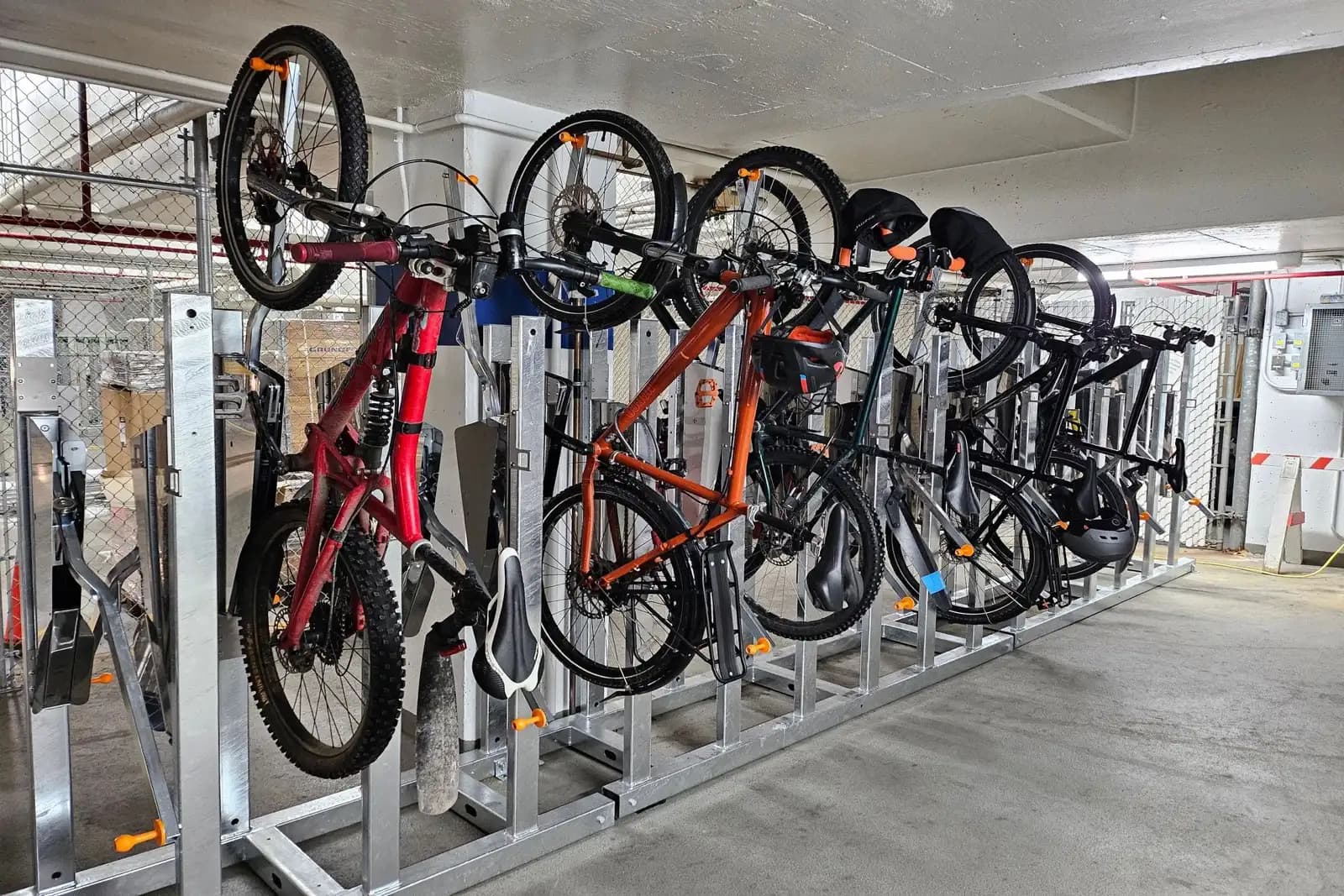
Wall-mounted vertical hooks: - 0.6 m² per bike (highest density on wall) - Lowest cost per space - Requires user to lift bike to chest height - Best for daily-use cyclists with moderate-weight bikes - Not ideal for heavy e-bikes or users with mobility limitations
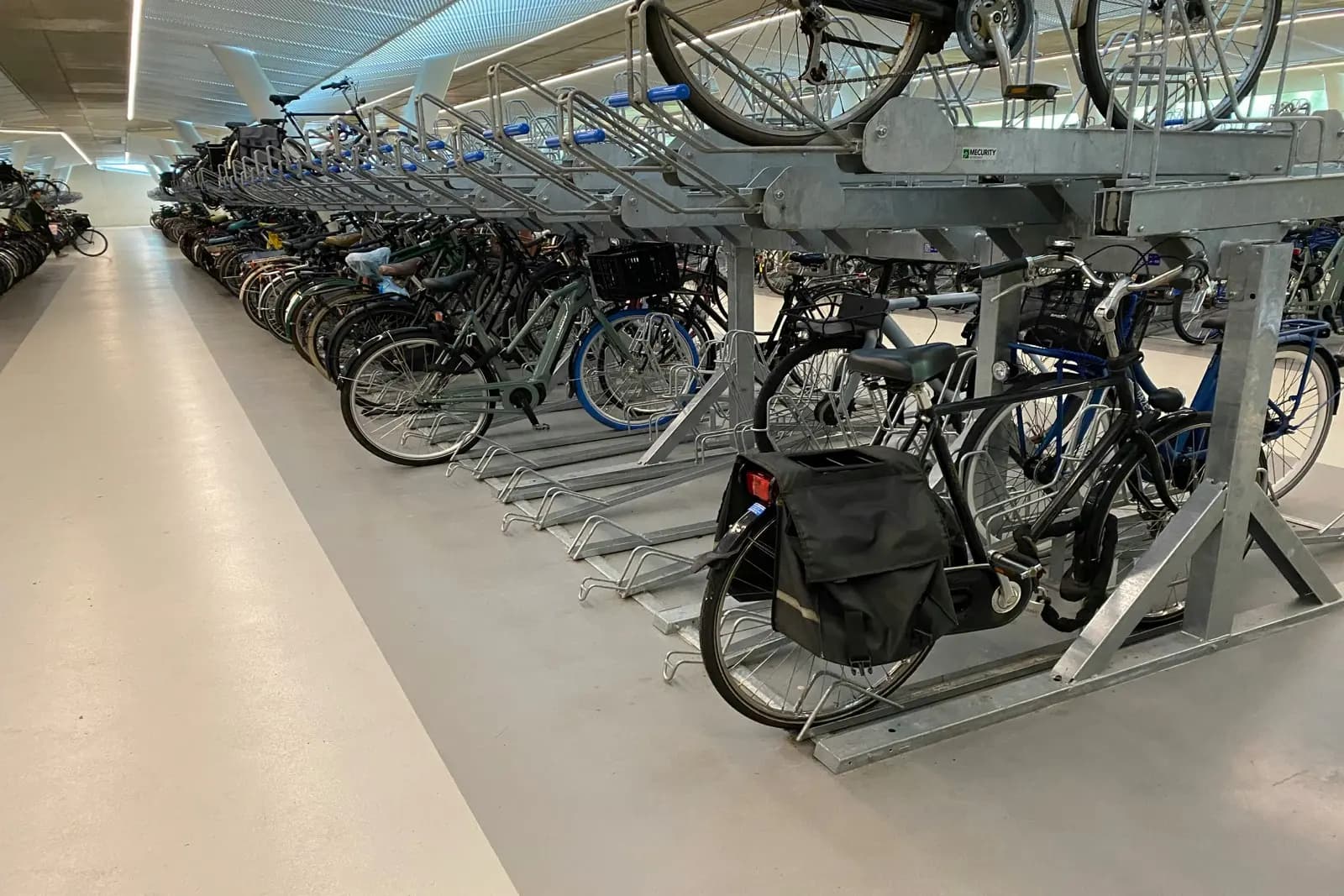
Two-tier rack systems: - 0.25 m² effective per bike (highest absolute density) - Mid-range cost per space - Requires user to operate gas-strut lift on upper tier - Best for high-volume bike rooms in multi-residential and transit - Specify upper-tier gas-strut rated for actual bike weight (30 kg for e-bikes)
Floor-standing vertical stands with lift assist: - 0.4 m² per bike - Mid-to-high cost per space - Easiest loading — bike rolls in at floor level - Best for accessibility and e-bike storage - Footprint requires floor space rather than wall space
Floor-standing horizontal racks: - 1.2 m² per bike (lowest density) - Lowest cost per space - Easiest loading - Best for renters and temporary installations - Used as supplementary capacity rather than primary
Bike lockers (individual): - 1.5 m² per bike (most space) - Highest cost per space - Maximum security and weather protection - Best for premium tier (often charge-by-month) - Typically supplement rather than replace rack-based parking
Recommended mix for typical multi-residential bike room: - 60% wall-mounted vertical hooks (cost-effective baseline) - 30% two-tier racks (high-density power users) - 10% bike lockers (premium tier)
Step 3: Size the Bike Room
For a 100-unit Toronto residential development requiring 90 long-term spaces at 0.9/unit:
- •60 wall hooks × 0.6 m² = 36 m²
- •27 two-tier spaces × 0.25 m² = 7 m²
- •9 lockers × 1.5 m² = 14 m²
- •Aisles and circulation: 15-20% of equipment area = ~12 m²
- •Total bike room: ~70 m²
For a 100-unit Vancouver development requiring 125 long-term spaces at 1.25/unit:
- •75 wall hooks × 0.6 m² = 45 m²
- •38 two-tier spaces × 0.25 m² = 10 m²
- •13 lockers × 1.5 m² = 20 m²
- •Aisles and circulation: ~15 m²
- •Total bike room: ~90 m²
These are minimums; actual rooms typically run 10-20% larger to accommodate maintenance access and future capacity additions.
Step 4: Specify Ceiling and Aisle Dimensions
Ceiling height: - Minimum 2.4 m for wall-mounted hooks (allows bike fork clearance plus user reach) - Minimum 3.0 m for two-tier racks (allows upper-tier swing and gas-strut clearance) - 2.7-3.0 m typical to accommodate mixed equipment and future flexibility
Aisle width: - Minimum 1.2 m between rack rows for single-side access - Minimum 1.5 m for two-tier racks (allow upper-tier loading) - Minimum 1.5 m for accessibility-prioritized installations - 1.8-2.0 m for primary circulation in larger rooms
Step 5: Mechanical and Electrical
HVAC: - Heated to 5-15 °C in winter (avoid below freezing — water from snow on bikes will freeze) - Cooled passively in summer (no AC required for bike rooms) - 30-60% relative humidity target to prevent corrosion of stored bikes - 6 air changes per hour minimum ventilation to manage moisture
Electrical: - Lighting: 150 lux minimum per CSA Z321 standard, motion-activated for energy efficiency - LED strip or troffer fixtures, color temperature 4000K (cool white) - Optional GFCI outlets at 1 per 2-3 racks for e-bike charging (110V, IP44 rated) - Emergency egress lighting per provincial building code - Card-access reader and electric strike on entry door
Plumbing: - Floor drains in entry zone for snow runoff - Slope 1-2% from rack zone to drains - Dedicated bike-wash station (optional but increasingly common — mop sink with bike-friendly height)
Step 6: Floor Surface and Drainage
Bike rooms see daily delivery of snow, water, and grit on bike wheels. Specify:
Floor finish (in priority order): 1. Sealed concrete with epoxy coating — most durable, easy to clean 2. Vinyl tile — cushioned, quieter, replaceable 3. Sealed polished concrete — premium architectural finish
Avoid: carpet, laminate, hardwood, untreated concrete
Drainage: - Floor drains every 6-8 m of room length - Slope 1-2% to drains - Drain connection to building stormwater (check provincial requirements; some jurisdictions require sanitary connection)
Step 7: Security
Access control: - Card-access entry restricted to building occupants - No public access during any hours - Audit trail of entry events retained 90 days minimum
Surveillance: - CCTV camera coverage of entire room - Recording retention minimum 30 days - Camera positioning: one per 50 m² minimum, covering all entry points and any blind corners
Lighting: - 150 lux minimum at floor level - Motion-activated with 5-minute timeout - Emergency egress lighting on backup power
Emergency call: - Emergency call button at room interior connected to building security desk or 911
Bike-specific theft prevention: - All racks anchored to structural elements (walls, floor, ceiling) so the rack itself cannot be removed - Encourage occupants to use U-locks on frame plus rear wheel - Optional: bike registration program with serial number recording for police reporting
Step 8: Accessibility
Path of travel: - Accessible from main building entrance with no stairs or unmanageable thresholds - 1.2 m minimum corridor width on the path - Door operators on bike room entry
Inside the room: - 1.5 m minimum aisles for accessible primary circulation - Some lower-mounted hooks (1.4-1.5 m off floor) for shorter users - Some floor-standing racks for users who can't lift bikes - Some larger spacing for cargo bikes and adaptive cycles
Step 9: E-Bike Provisions
E-bikes are increasingly standard, especially in Vancouver and Montréal:
- •Reinforced wall hooks rated for 30-40 kg (versus standard 20-25 kg)
- •Lower mounting heights (1.4-1.5 m) so users don't need to lift heavy e-bikes overhead
- •Charging outlets GFCI-protected, IP44 rated, at 1 per 2-3 racks
- •Cargo e-bike accommodation — provide some floor-standing or expanded-locker spaces (90 cm × 220 cm)
- •Battery-removal area — secure indoor space where users can remove and carry batteries to apartments
Step 10: Documentation for Permit Submission
Compile the following for permit application:
1. Capacity calculation showing how the requirement was met 2. Equipment specifications with manufacturer, model, and material specs 3. Layout drawings showing rack positions, aisles, and accessibility paths 4. Mechanical drawings showing HVAC, drainage, and any electrical 5. Electrical drawings showing lighting, outlets, security, emergency systems 6. Engineered drawings stamped by qualified structural engineer for racks anchored to non-standard surfaces 7. CAN/CSA Z321 conformance documentation confirming bicycle parking standard compliance 8. Bylaw compliance memo referencing the specific municipal bylaw and how each requirement is met
Step 11: Installation and Commissioning
Pre-installation: Site visit to confirm dimensions and structural conditions; coordinate with electrical and HVAC contractors for scheduling; confirm anchor points free of conflict with electrical conduit and HVAC ducting.
Installation: Install per stamped drawings; document anchor torque values on installation report; photograph completed installation for record.
Commissioning: Verify all racks are anchored per spec; test card-access entry system; verify CCTV coverage of entire room; test emergency call button; verify lighting levels meet 150 lux at floor.
Post-installation: Provide owner with as-built drawings; provide warranty documentation; schedule first-year inspection.
Working With Specialists
Bike rooms involve coordination across architectural, structural, mechanical, electrical, security, and bicycle parking specialty consultants. A qualified bike rack supplier with experience in Canadian Class A bike rooms can serve as the bicycle parking specialty consultant, providing capacity calculations, equipment specifications, layout drawings sized to bylaw ratios, coordination with mechanical and electrical contractors, installation by certified crews, post-installation inspection and commissioning, and warranty support.
BikeRacks.ca has supplied and installed Class A-compliant bike rooms for residential, commercial, institutional, and municipal projects across Canada with full bylaw documentation. Free design consultation and equipment recommendations are available for any Canadian Class A bike room project.
Frequently Asked Questions
How much floor area should I allocate per bike in a Class A room?
Plan 0.6 m² per bike with two-tier systems, 0.25 m² with vertical wall hooks, or 0.9–1.2 m² with floor-standing horizontal racks. Add aisle and circulation space (1.2 m minimum aisle width). A 50-bike Class A room with two-tier racks fits in roughly 35–40 m².
Does the bike room need ventilation?
Yes — 6 air changes per hour minimum. Bikes brought in wet from rain or snow create humidity and odour buildup; ventilation prevents mould on walls and corrosion on bike components. Mechanical ventilation with humidity control is preferred over passive vents.
Should the bike room be on a slab or in the basement?
Either works. Slab-level rooms with direct access to building entrance are most convenient for daily use. Basement bike rooms offer better security and climate control but require ramp or elevator access — ramps preferred (max 5% grade) for cyclists pushing bikes.
Related Resources
- •Browse our full catalogue of commercial bike racks and bike shelters engineered for Canadian conditions.
- •Explore bike parking solutions by sector: residential, commercial offices, municipal, and education.
- •Local installation in major Canadian cities: Toronto, Vancouver, Montreal, Calgary, Ottawa.
- •See frequently asked questions or contact our team for a free quote in 24 hours.
Frequently Asked Questions
Where can I buy commercial bike racks in Canada?
BikeRacks.ca delivers bike racks across all 10 Canadian provinces and 3 territories. Order online or contact us for a free quote with fast shipping from our Ontario and BC warehouses.
What is the best material for outdoor bike racks in Canada?
Hot-dip galvanized steel is the best choice for outdoor installations in Canada. The zinc coating resists road salt, de-icing chemicals, and freeze-thaw cycles for 20+ years with zero maintenance.
How much do commercial bike racks cost?
Commercial bike rack prices range from $75-$2,500 depending on type, material, and quantity. Basic inverted-U racks start at about $200 installed. Volume discounts available for 10+ units.