Key Takeaways
- ✓E-bikes weigh 18-30 kg vs 9-12 kg for standard bikes — load ratings must double from typical rack specifications.
- ✓Spring-loaded or gas-strut assist hooks are mandatory for e-bike vertical storage; static hooks cause user injuries and rack failures.
- ✓Battery removal and indoor storage at 5-15°C is required — lithium-ion batteries lose 20-40% capacity stored sub-zero.
- ✓New construction in 2026: target 30-50% of Class A long-term spaces as e-bike compatible with charging outlets.
Key Takeaways
- •E-bikes weigh 18-30 kg vs 9-12 kg for standard bikes — load ratings must double from typical rack specifications.
- •Spring-loaded or gas-strut assist hooks are mandatory for e-bike vertical storage; static hooks cause user injuries and rack failures.
- •Battery removal and indoor storage at 5-15°C is required — lithium-ion batteries lose 20-40% capacity stored sub-zero.
- •New construction in 2026: target 30-50% of Class A long-term spaces as e-bike compatible with charging outlets.
E-bike adoption in Canadian cities is climbing 25-40% annually as battery technology improves and prices drop. For property managers, this creates immediate retrofit pressure and long-term planning implications for new construction. The good news: e-bike compatibility doesn't require rebuilding — it requires specific equipment upgrades.
E-Bike vs Standard Bike: Specification Differences
The mechanical differences between e-bikes and standard bikes drive specification differences in bike parking:
| Attribute | Standard bike | E-bike | Cargo e-bike |
|---|---|---|---|
| Weight | 9-12 kg | 18-30 kg | 30-45 kg |
| Frame thickness | 25-35 mm | 35-50 mm | 50-70 mm |
| Wheelbase | 950-1050 mm | 1050-1150 mm | 1200-1500 mm |
| Battery | None | 3-5 kg | 4-7 kg |
| Charging | None | 15A circuit | 15-20A circuit |
E-bike weight is the primary specification driver. A wall hook rated for 15 kg static load (adequate for a road bike) will fail catastrophically under a 30 kg cargo e-bike during the lift motion (dynamic load up to 60 kg).
E-Bike Compatible Equipment Selection
Three equipment categories work for e-bike storage:
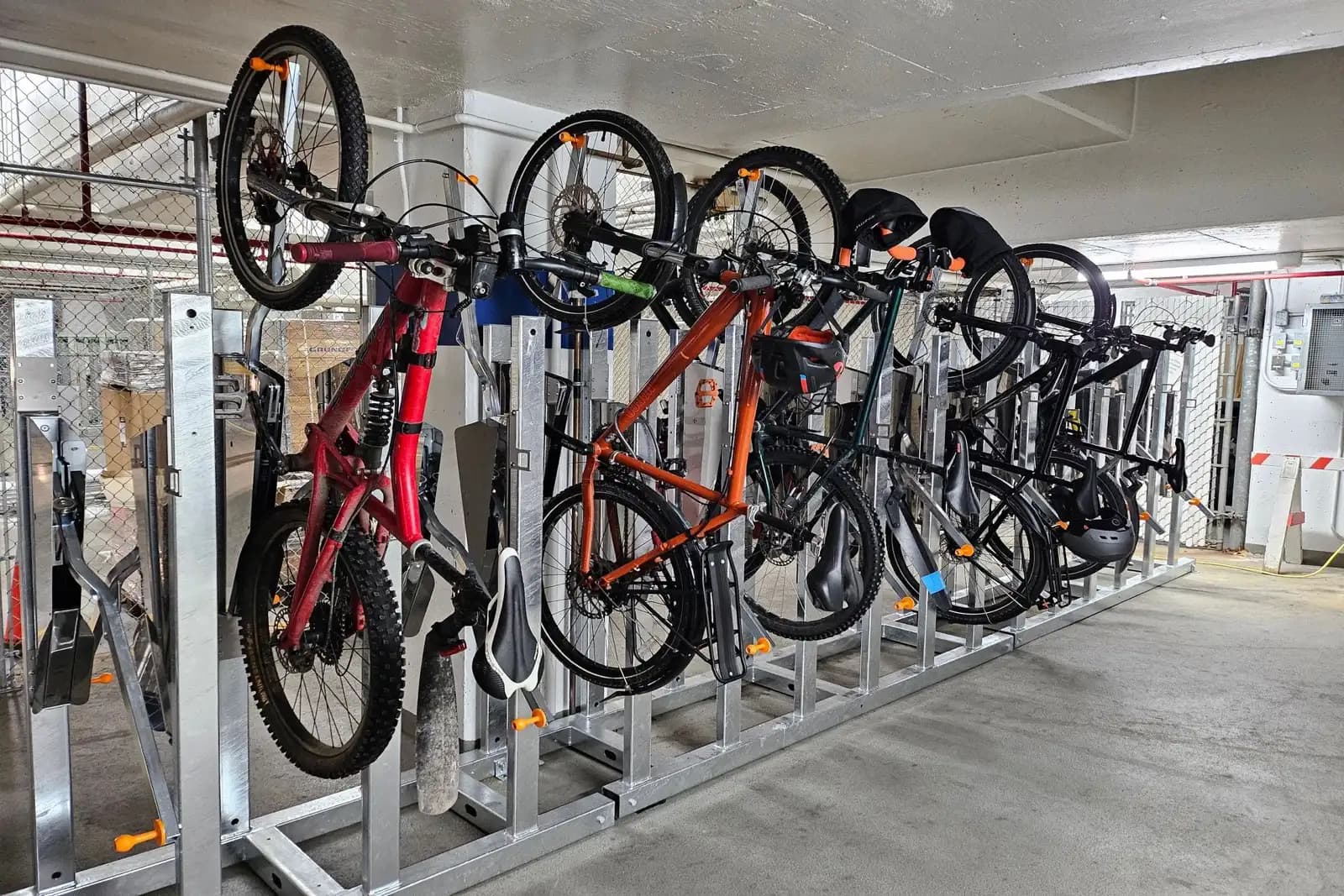
Spring-loaded vertical wall hooks — torsion-spring assist reduces lift effort by 20-30%. Rated for 25-30 kg static. Cost: $80-$150 per hook. Best for: multi-residential bike rooms with mixed standard/e-bike storage.
Gas-strut assisted vertical hooks — full assist for the lift motion; user effort under 5 kg even for heavy e-bikes. Rated for 30 kg static / 60 kg dynamic. Cost: $100-$200 per hook. Best for: premium condo bike rooms, properties marketing e-bike accommodation.
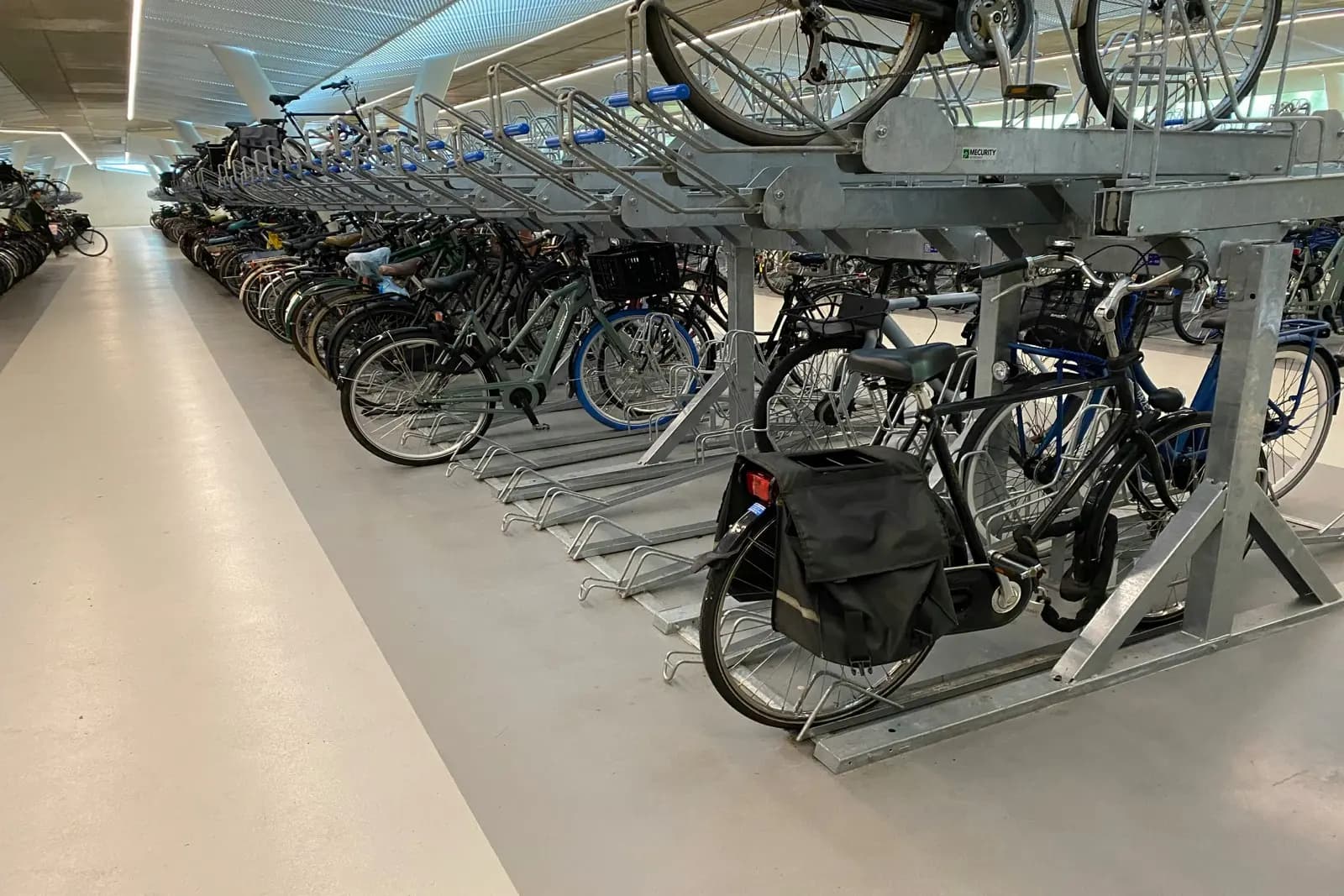
Low-rail or floor-standing racks (no lift required) — bikes loaded at ground level without lifting. Two-tier systems with gas-strut upper tier eliminate the lift entirely. Cost: $300-$800 per bike. Best for: bike rooms with mostly e-bike storage, commercial/transit facilities with daily heavy use.
Bike lockers — fully enclosed individual storage with electronic locks. Drive-in floor-level access; no lifting. Cost: $1,500-$3,000 per locker. Best for: premium properties offering paid-tier bike storage.
Charging Infrastructure Requirements
E-bike batteries charge in 3-6 hours from a standard 15A household circuit. For multi-residential bike rooms accommodating e-bikes:
Outlet placement — within 2 m of every e-bike-compatible storage position. Wall-mounted at 1.0 m height (reach over a parked bike is awkward).
Circuit capacity — one 15A circuit per 4-6 simultaneous chargers. Each e-bike charger draws 1.5-3 A during normal charging. Avoid daisy-chaining; dedicated circuits prevent breaker trips during peak charging.
Cable management — wall hooks for storing 1.5-2 m charging cables when not in use. Prevents trip hazards and cable damage from being stepped on.
Locking outlets — for premium installations, lockable outlet covers prevent unauthorized use. Card-access integration available with newer systems.
Fire safety — lithium-ion battery fire risk is low but real. Specify fire-rated bike room separation (1-hour rating typical) in new construction; install smoke detection if not already present; consider fire suppression (Inergen or chemical-foam) for high-density storage.
Battery Storage in Canadian Winters
This is where Canadian property managers need to pay special attention: lithium-ion batteries degrade rapidly when stored sub-zero.
Storage temperature recommendations: - Optimal: 5-15 °C indoor - Acceptable: 0-25 °C - Damaging: below 0 °C or above 35 °C for extended periods - Capacity loss: sub-zero storage for one winter typically reduces battery capacity 20-40%
For Class A bike rooms in Canadian climates:
Heat the bike room to 5-15 °C minimum during winter months. Mechanical heating with humidity control (30-60% RH) preserves both batteries and bike components.
Separate battery storage — provide a separate climate-controlled storage cabinet or room where residents can store batteries during winter while keeping the bike (without battery) in the bike room. This option works well for older buildings where heating the entire bike room is impractical.
Resident education — provide written guidance on battery removal and storage. Many residents don't realize sub-zero storage damages batteries; clear signage and resident-handbook content prevent capacity loss.
Retrofitting Existing Bike Rooms
For existing bike rooms being retrofit for e-bike compatibility:
Phase 1 — Assessment ($500-$2,000) - Audit current rack types and load ratings - Identify e-bike-compatible vs incompatible storage positions - Measure available wall space for new hooks - Survey electrical capacity and outlet locations
Phase 2 — Equipment upgrade ($150-$300 per e-bike position) - Replace static hooks with spring-loaded or gas-assist - Add wall reinforcement if needed (timber blocking between studs) - Increase rack spacing to accommodate wider e-bike frames
Phase 3 — Charging infrastructure ($300-$800 per outlet) - Install dedicated 15A circuits to bike room electrical panel - Mount outlets at 1.0 m height near each e-bike position - Add cable management hooks
Phase 4 — Climate control ($2,000-$15,000) - Install heating if bike room is currently unheated - Add humidity monitoring - Consider battery storage cabinet if individual battery removal is preferred
Total retrofit cost for a 30-bike room with 10 e-bike positions: typically $5,000-$15,000.
New Construction Recommendations
For property managers and developers planning new construction in 2026 and beyond:
Class A space allocation: Plan 30-50% of long-term spaces as e-bike compatible. This fraction will likely increase to 60-70% by 2030.
Charging outlets: Install one outlet per e-bike-compatible position. Standard 15A circuits; future-proof for 20A by oversizing breaker panel.
Climate control: Heated bike room at 5-15 °C with 30-60% humidity control. Mechanical ventilation 6 air changes per hour to prevent moisture buildup.
Security: Card-access entry with CCTV. Visible signage about e-bike battery removal best practices. Optional locker bank for individual battery storage.
Cargo e-bike accommodation: Reserve 5-10% of bike room floor space for cargo e-bikes (longer wheelbase, higher weight). Specify wide-stance floor racks rather than wall hooks for cargo bikes.
Pricing Summary
E-bike compatible equipment pricing in Canadian markets, 2026:
| Item | Cost installed |
|---|---|
| Spring-loaded vertical wall hook | $120-$200 |
| Gas-strut assist vertical hook | $200-$300 |
| Two-tier system (e-bike rated) | $600-$1,200 per bike |
| Premium bike locker (electronic lock) | $1,500-$3,000 |
| Charging outlet installation | $300-$800 |
| Bike room heating retrofit | $2,000-$15,000 |
Related Resources
- •Browse vertical bike racks and bike lockers suitable for e-bike storage.
- •Explore residential, multi-residential, and commercial bike parking solutions.
- •See our Class A bike room specification guide for new construction.
- •Contact BikeRacks.ca for free site assessment for e-bike retrofit projects.
Frequently Asked Questions
Can I use my existing bike room for e-bike storage?
Most existing bike rooms can be retrofit for e-bike compatibility. The two critical changes are: (1) replace static hooks with spring-loaded or gas-assist versions rated for 30 kg static load, and (2) install 15A outlets near e-bike storage positions. Total retrofit cost typically $5,000-$15,000 for a 30-bike room with 10 e-bike positions.
Do I need to install charging outlets for every bike space?
For new construction: install outlets at 30-50% of Class A long-term spaces. For retrofit: prioritize outlets near 20-40% of positions initially, with conduit pre-installed for future expansion. Each 15A circuit supports 4-6 simultaneous chargers.
What happens to e-bike batteries stored outdoors in winter?
Lithium-ion batteries lose 20-40% capacity when stored at sub-zero temperatures over the Canadian winter. The loss is partially reversible if the battery is brought back to 15-25 °C and recharged slowly, but capacity rarely recovers fully. Always store e-bike batteries indoors at 5-15 °C during winter.
How do I prevent fire risk from charging e-bikes in the bike room?
Lithium-ion battery fire risk is low but real. Mitigations: (1) specify fire-rated bike room separation (1-hour rating) in new construction, (2) install smoke detection, (3) require manufacturer-approved chargers only (no aftermarket), (4) prohibit overnight charging in high-density installations, (5) consider fire suppression for premium installations. Insurance carriers increasingly require some or all of these for high-density e-bike storage.
Frequently Asked Questions
Where can I buy commercial bike racks in Canada?
BikeRacks.ca delivers bike racks across all 10 Canadian provinces and 3 territories. Order online or contact us for a free quote with fast shipping from our Ontario and BC warehouses.
What is the best material for outdoor bike racks in Canada?
Hot-dip galvanized steel is the best choice for outdoor installations in Canada. The zinc coating resists road salt, de-icing chemicals, and freeze-thaw cycles for 20+ years with zero maintenance.
How much do commercial bike racks cost?
Commercial bike rack prices range from $75-$2,500 depending on type, material, and quantity. Basic inverted-U racks start at about $200 installed. Volume discounts available for 10+ units.