Key Takeaways
- ✓Calgary's Land Use Bylaw 1P2007 sets bicycle parking minimums that vary by district designation and land use.
- ✓Prairie climate requires 1500-1800 mm frost depth foundations and 2.0-2.5 kPa snow loads on bike shelters.
- ✓Plus-15 elevated walkway connections enable indoor Class A bike rooms with weather-protected building-entry access.
- ✓Calgary's chinook events cause extreme temperature swings (40°C in 24 hours) that destroy painted-only finishes; specify hot-dip galvanized.
Key Takeaways
- •Calgary's Land Use Bylaw 1P2007 sets bicycle parking minimums that vary by district designation and land use.
- •Prairie climate requires 1500-1800 mm frost depth foundations and 2.0-2.5 kPa snow loads on bike shelters.
- •Plus-15 elevated walkway connections enable indoor Class A bike rooms with weather-protected building-entry access.
- •Calgary's chinook events cause extreme temperature swings (40°C in 24 hours) that destroy painted-only finishes; specify hot-dip galvanized.
Calgary's bicycle parking requirements work within the City of Calgary's Land Use Bylaw 1P2007 framework. Developers planning multi-residential, commercial, or institutional projects in Calgary need to understand both the prescribed minimums and the prairie-climate engineering that determines equipment longevity.
Calgary Land Use Bylaw 1P2007: Bicycle Parking Minimums
Calgary's Land Use Bylaw 1P2007 sets bicycle parking minimums by district and use:
Multi-residential in M-G (multi-residential medium grade) and CC-X (centre city mixed-use) districts requires 0.5 long-term spaces per dwelling unit plus visitor parking. Central districts (CC-COR, CC-MH) can require higher ratios.
Office and commercial uses require approximately 0.5 spaces per 200 m² of gross floor area with the split between long-term (employee) and short-term (visitor) determined by occupancy assumptions.
Mixed-use developments combine residential, office, and retail ratios proportionally to the floor area of each use.
Institutional uses (schools, hospitals, civic facilities) calculate from staff and student headcounts plus public visitor projections.
The Calgary Bicycle Strategy and the Climate Resilience Strategy both target increased active transportation, so the City has signalled continued upward adjustment of bicycle parking minimums in upcoming zoning bylaw amendments.
Class A and Class B Specifications
Calgary's Class A (long-term) requirements typically include:
- •Indoor or weather-protected bike storage
- •Secure access (card/fob entry preferred)
- •Available 24/7 to building occupants
- •Two locking points per CSA Z321
- •Spacing 600 mm centre-to-centre minimum
Class B (short-term) requirements:
- •Outdoor near principal building entrance
- •Visible from the entrance
- •Open to public during business hours
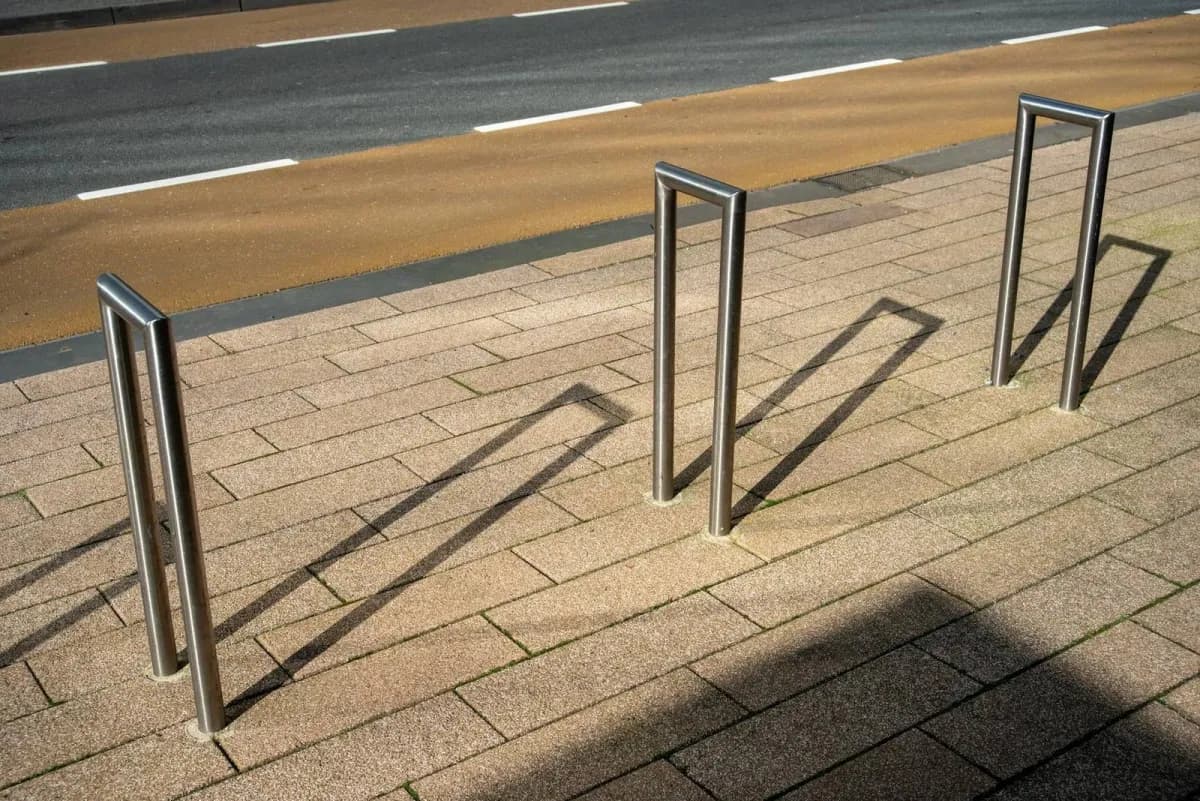
- •Inverted-U or post-and-ring with two locking points
Prairie Climate Engineering Requirements
Calgary's prairie climate creates engineering challenges different from coastal or Great Lakes regions:
Frost depth: 1.5-1.8 m for in-ground installations. Foundations must extend below the local frost line — typically achieved with concrete piers or sonotubes. Surface-mount installations require frost-protected slabs (insulated below or designed with thickened-edge perimeter).
Snow load: 2.0-2.5 kPa for bike shelter roof structures in Calgary. Northern Alberta projects (Grande Prairie, Fort McMurray) require 2.5-3.0 kPa. Roof slope minimum 15° for active snow shedding.
Chinook events: Calgary experiences chinook winds that can raise temperatures 40°C in 24 hours (e.g., -25°C to +15°C). These extreme thermal cycles destroy painted-only finishes within 2-3 years through differential expansion. Hot-dip galvanized steel (ASTM A123) accommodates the thermal cycling without coating failure.
Wind load: Calgary's foothills exposure creates 1.0-1.2 kPa wind loads on elevated bike shelter installations — higher than most Canadian cities. Engineered anchorage required for any structure over 2.4 m tall.
UV exposure: Calgary's elevation (1,045 m) and clear-sky days produce higher annual UV exposure than most Canadian cities. Polycarbonate roof panels should specify UV-stabilized formulations rated for 15+ year service life.
Plus-15 Network Integration
Calgary's downtown Plus-15 elevated walkway system enables a unique bike parking strategy: indoor Class A bike rooms inside the buildings with weather-protected access via the Plus-15 network. This means:
- •No outdoor exposure for cyclists entering or leaving the building
- •Integration with building security via card/fob systems already in place for Plus-15 access
- •Bilingual signage along Plus-15 routes pointing to bike rooms
Plus-15-connected bike rooms typically charge a small monthly access fee ($20-$50) but command premium pricing because they eliminate the "ride home in -30°C" deterrent.
Equipment Specifications for Calgary Projects
Recommended equipment for Calgary projects:
Outdoor Class B short-term: Hot-dip galvanized inverted-U racks with optional powder-coat colour. Specify CSA Z321 spacing and 4.5 kN anchor pull-out resistance.
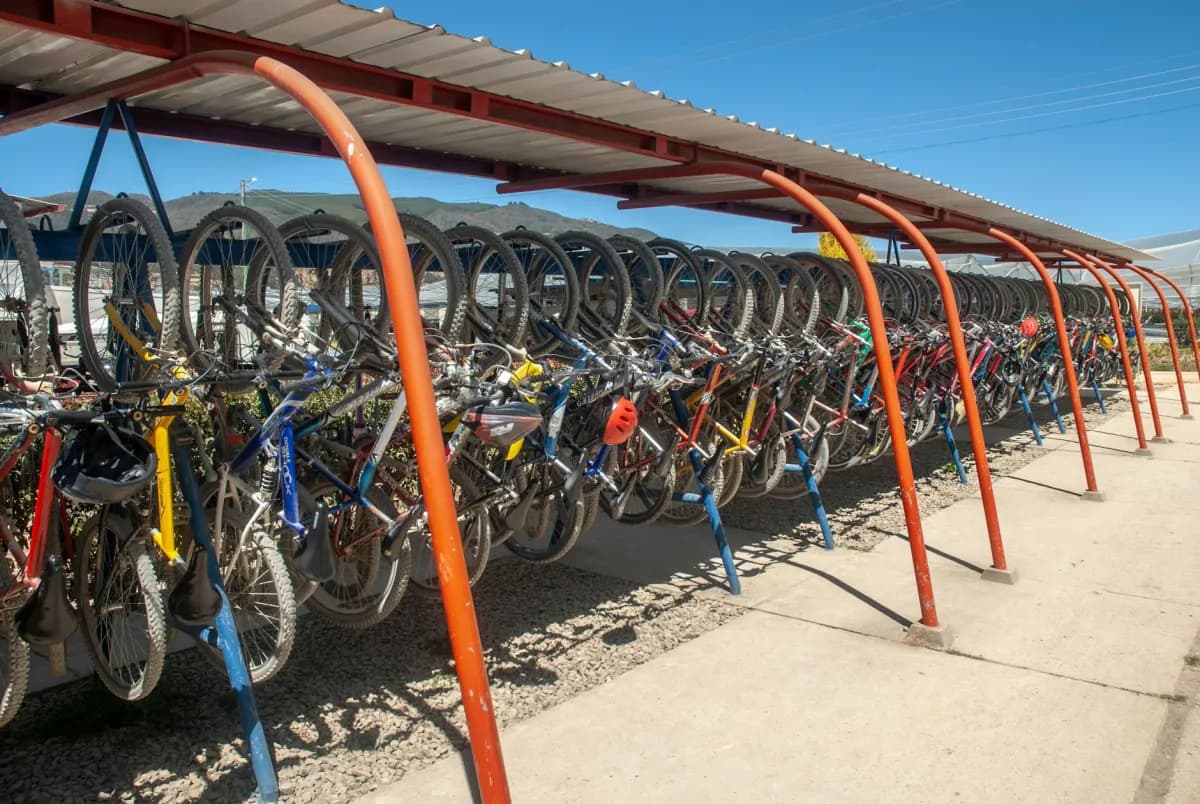
Outdoor covered Class A medium-term: Aluminum or galvanized steel bike shelter with UV-stabilized polycarbonate or standing-seam galvanized steel roof. 2.0-2.5 kPa snow load, 1.0-1.2 kPa wind load, 15-20° roof slope.
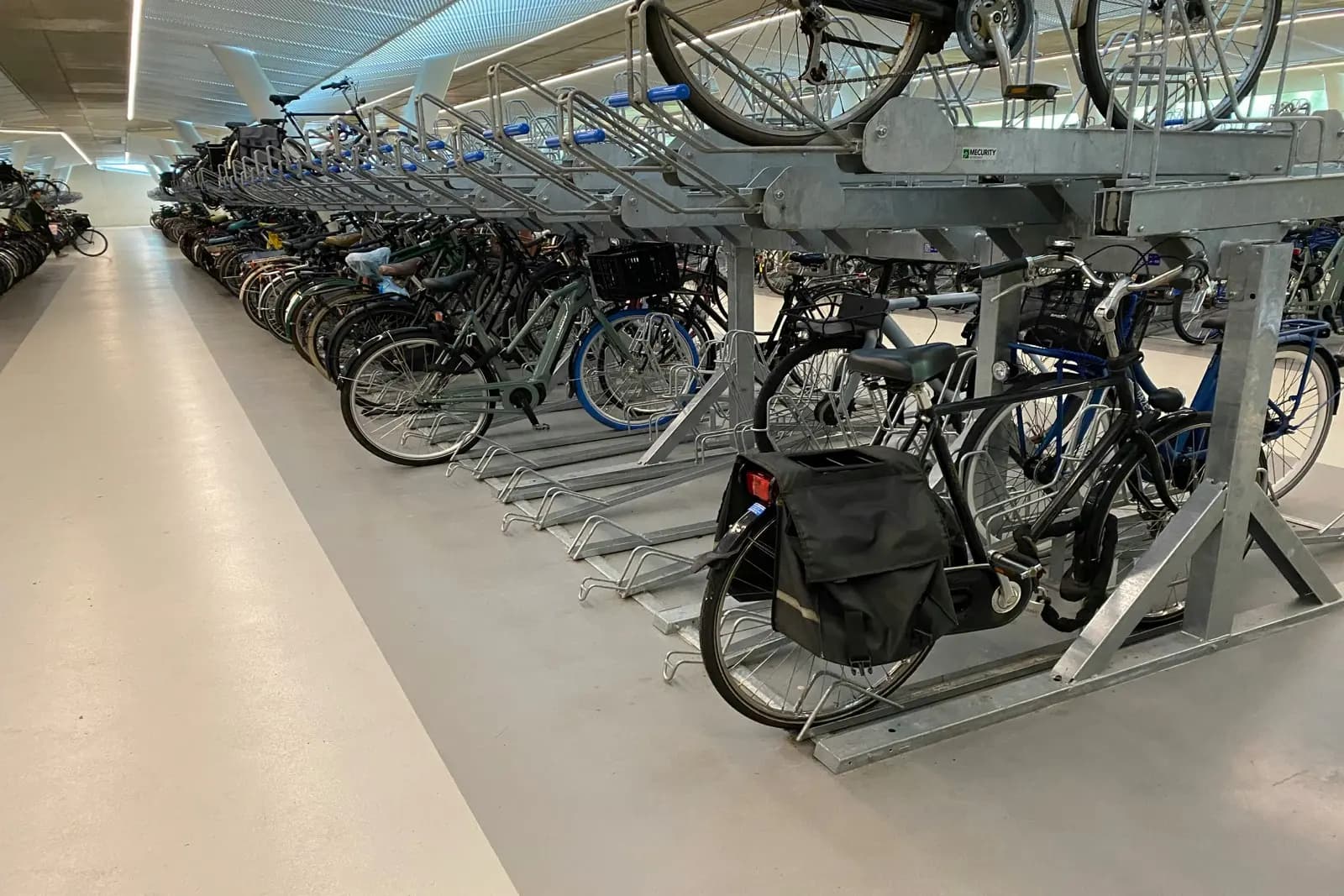
Indoor Class A long-term (bike rooms): Two-tier rack systems for maximum density in Plus-15-connected bike rooms. Vertical wall hooks or wall rail systems for mixed-bike-size storage. CCTV recommended; card-access entry standard.
E-bike compatibility: Spring-loaded or gas-assist hooks; charging outlets at 30-50% of long-term spaces for new construction.
Permit Submission Documentation
For Calgary bicycle parking permit submissions, prepare:
1. Site plan with rack locations, accessibility routes, and integration with Plus-15 (downtown) 2. Equipment specifications including ASTM A123 galvanizing, CSA Z321 compliance 3. Stamped engineering drawings for foundations and shelter structures 4. Snow-load calculations at 2.0-2.5 kPa 5. Wind-load calculations for any structure over 2.4 m tall 6. Chinook thermal-cycling analysis for non-galvanized finish specifications
BikeRacks.ca provides full Calgary installation services including stamped engineering drawings, chinook-rated material specifications, and Plus-15 bike room layout consultation.
Related Resources
- •Browse galvanized outdoor bike racks and bike shelters engineered for Calgary climate.
- •Compare with Edmonton and Winnipeg bylaw frameworks.
- •See bike rack installation in Calgary.
- •Read our Class A bike room specification guide.
Frequently Asked Questions
What is the minimum bicycle parking requirement for a Calgary multi-residential project?
Calgary's Land Use Bylaw 1P2007 typically requires 0.5 long-term Class A spaces per dwelling unit in standard multi-residential zones, with higher ratios in central districts. Visitor parking adds approximately 10% of long-term capacity. Always verify with current bylaw and Land Use Bylaw amendments.
Do chinook events damage bike racks in Calgary?
Yes — painted-only finishes fail within 2-3 years due to differential thermal expansion during chinook events (40°C swings in 24 hours). Hot-dip galvanized steel (ASTM A123) survives these thermal cycles because the zinc-iron metallurgical bond accommodates the expansion. Always specify galvanized for Calgary outdoor installations.
How can Plus-15 access reduce bike commuting friction?
Plus-15-connected bike rooms eliminate the "outdoor weather penalty" for cyclists. Riders can enter the building, store their bike indoors, and walk to their workplace entirely indoors. This is particularly valuable in Calgary's cold winters and chinook windy conditions. Premium downtown bike rooms typically charge $20-$50 monthly for this access.
What snow load should I specify for a Calgary bike shelter?
2.0-2.5 kPa for Calgary-region installations. Northern Alberta (Grande Prairie, Fort McMurray) requires 2.5-3.0 kPa. Roof slope 15-20° minimum for active shedding. Polycarbonate or standing-seam galvanized steel both perform well at these specifications.
Frequently Asked Questions
Where can I buy commercial bike racks in Canada?
BikeRacks.ca delivers bike racks across all 10 Canadian provinces and 3 territories. Order online or contact us for a free quote with fast shipping from our Ontario and BC warehouses.
What is the best material for outdoor bike racks in Canada?
Hot-dip galvanized steel is the best choice for outdoor installations in Canada. The zinc coating resists road salt, de-icing chemicals, and freeze-thaw cycles for 20+ years with zero maintenance.
How much do commercial bike racks cost?
Commercial bike rack prices range from $75-$2,500 depending on type, material, and quantity. Basic inverted-U racks start at about $200 installed. Volume discounts available for 10+ units.