Key Takeaways
- ✓Bike room equipment costs $200-$500 per bike installed for two-tier systems; bike lockers run $1,500-$3,000 each.
- ✓Locker rental income at $20-$60/month generates $240-$720 per year per locker — typical payback period 3-5 years.
- ✓Two-tier rack systems deliver 0.25-0.6 m² per bike vs 0.9 m² for floor-mount inverted-U — a 3-4× density advantage that frees up sellable floor area.
- ✓E-bike compatible spaces command $50-$100/month premiums in some Vancouver and Toronto buildings.
Key Takeaways
- •Bike room equipment costs $200-$500 per bike installed for two-tier systems; bike lockers run $1,500-$3,000 each.
- •Locker rental income at $20-$60/month generates $240-$720 per year per locker — typical payback period 3-5 years.
- •Two-tier rack systems deliver 0.25-0.6 m² per bike vs 0.9 m² for floor-mount inverted-U — a 3-4× density advantage that frees up sellable floor area.
- •E-bike compatible spaces command $50-$100/month premiums in some Vancouver and Toronto buildings.
Beyond satisfying municipal bylaw minimums, well-designed bike rooms generate measurable returns for condo developers. The financial case combines amenity-pricing differentiation, locker rental revenue, density advantages over conventional storage, and reduced building-operating headaches.
The Cost Side: Bike Room Equipment Pricing
Per-bike installed equipment costs for new construction:
| Equipment type | Per-bike installed |
|---|---|
| Floor-mount inverted-U galvanized | $150-$300 |
| Wall-mounted static hook (residential) | $50-$120 |
| Wall-mounted spring-loaded hook | $120-$200 |
| Wall rail system (per metre, 3 bikes) | $250-$400 |
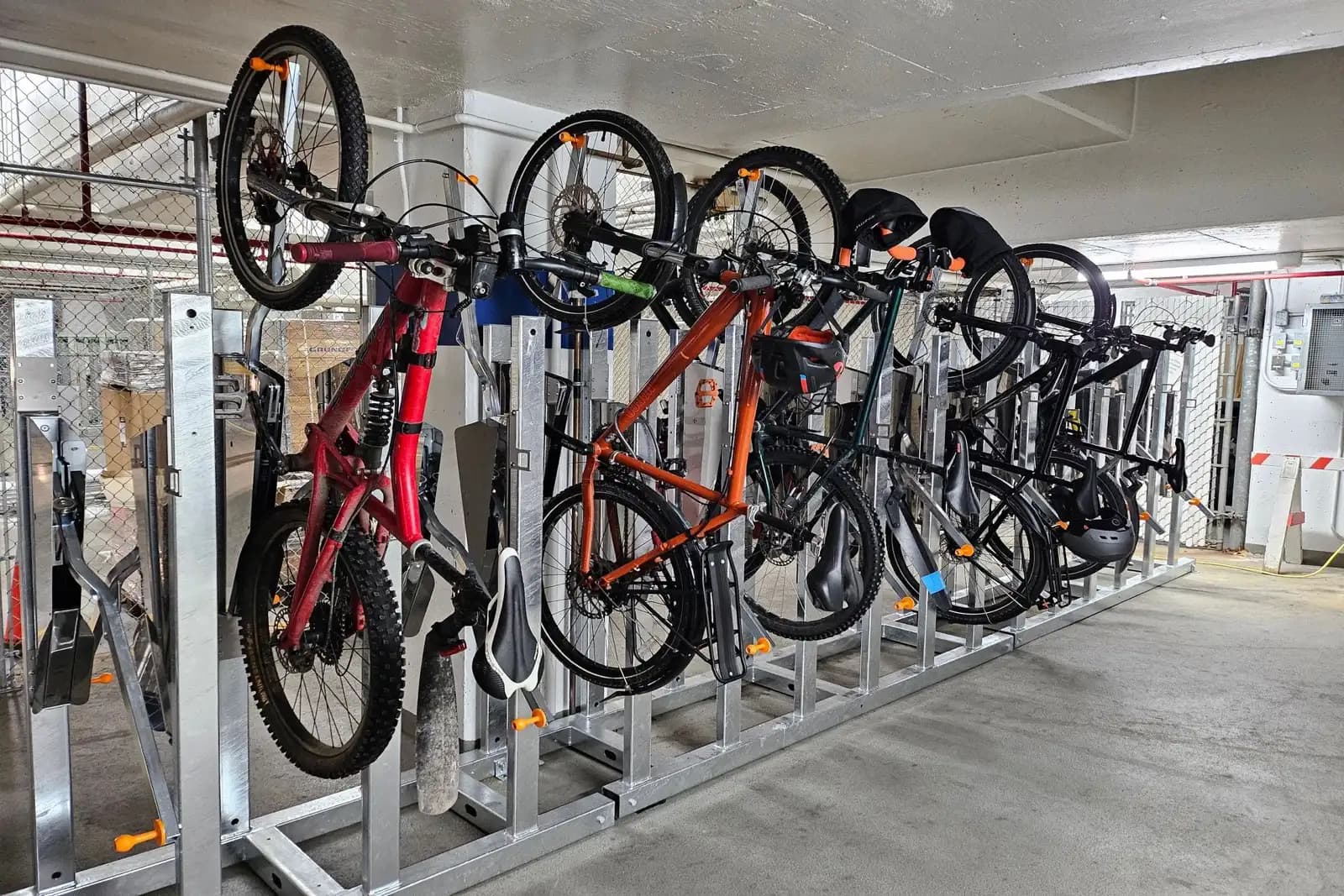
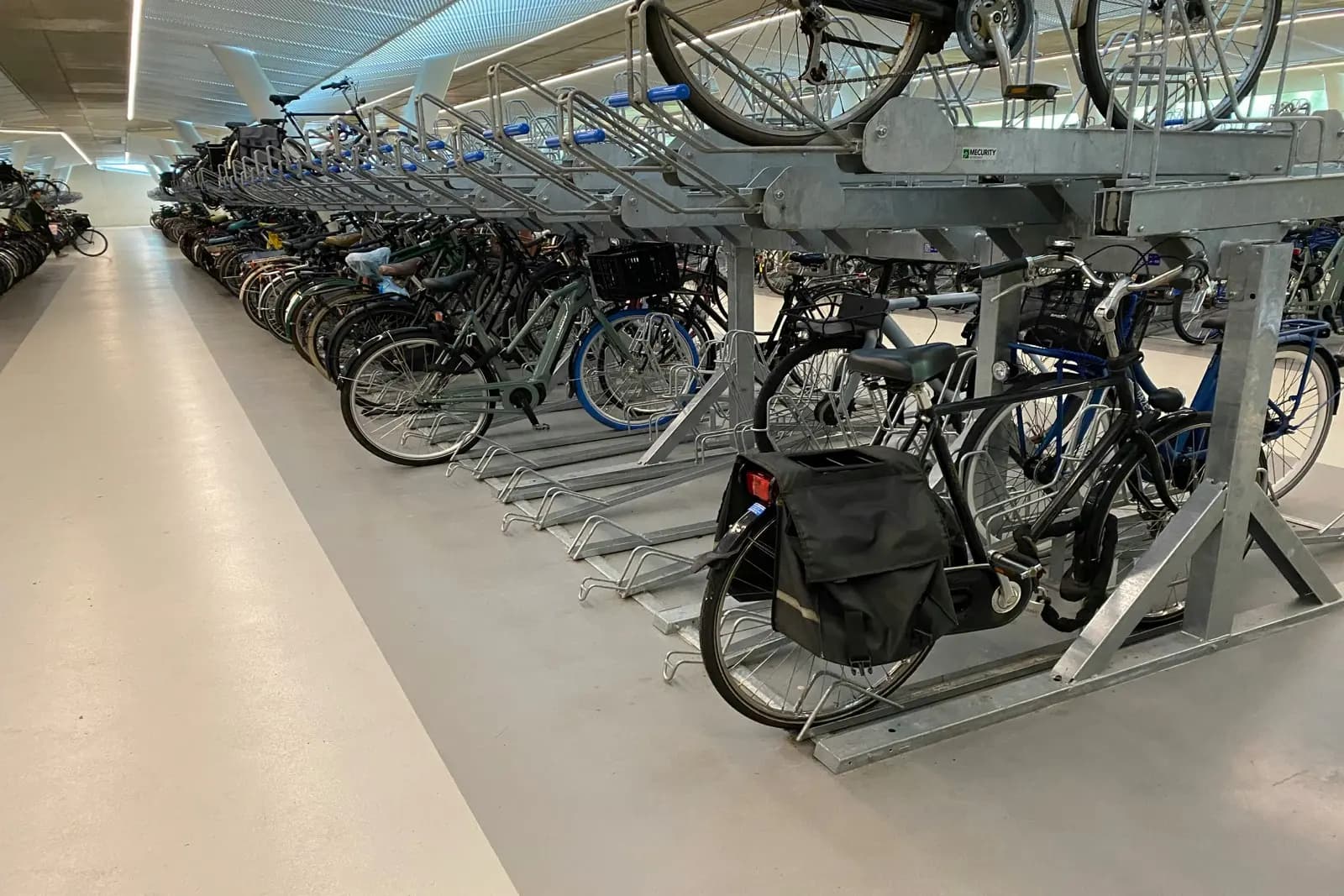
| Two-tier rack (per bike) | $200-$500 |
| Vertical wall hook (gas-strut, e-bike) | $200-$300 |
| Bike locker (electronic lock) | $1,500-$3,000 |
For a typical 100-unit Toronto condo requiring 90 long-term bike spaces (0.9 ratio per unit), equipment costs range from $25,000 (floor-mount inverted-U) to $45,000 (two-tier rack system). Visitor parking adds $3,000-$8,000 for outdoor Class B racks.
The capital cost difference between basic and premium bike room equipment is typically $15,000-$25,000 for a 100-unit project — small relative to total project cost (under 0.05% of a $50M-100M project).
The Density Argument: Two-Tier vs Floor-Mount
Two-tier rack systems deliver dramatic floor-area savings over conventional floor-mount inverted-U racks:
| System | Floor area per bike | 90-bike footprint |
|---|---|---|
| Floor-mount inverted-U | 0.9 m² | 81 m² |
| Vertical floor stand | 0.5 m² | 45 m² |
| Two-tier rack | 0.3 m² | 27 m² |
| Wall-mounted vertical hooks | 0.2 m² | 18 m² |
For a 100-unit Toronto condo at 0.9 spaces per unit, switching from inverted-U to two-tier racks frees 54 m² of floor area. At downtown Toronto's typical sellable rate of $12,000-$18,000 per m², this represents $650,000-$975,000 of potentially sellable floor area.
The catch: most of that floor area is in the underground parking garage, where conversion to other uses (storage lockers, gym, lounge) is the actual gain. Even at $200-$400 per m² of garage-level utility conversion, the 54 m² is worth $10,000-$22,000.
Bike Locker Rental Revenue
Premium bike storage — individual bike lockers with electronic locks — typically commands rental income:
Vancouver downtown condos: $40-$80/month per locker Toronto downtown condos: $30-$60/month Montreal Plateau condos: $25-$50/month Calgary downtown condos: $20-$40/month Smaller-city condos: $15-$30/month
A 100-unit downtown Toronto condo offering 20 premium bike lockers at $40/month generates $9,600 annual recurring revenue.
Capital cost: 20 lockers × $2,000 each = $40,000.
Payback period (gross): $40,000 / $9,600 = 4.2 years.
Net cash flow after maintenance (typically 5-10% annual): $8,640-$9,120 per year ongoing after payback.
For premium e-bike storage (with charging outlets, higher security), rental rates trend $50-$100/month, halving the payback period.
Premium Amenity Pricing for Condo Marketing
For new condo developments marketing to cycling-oriented buyers, well-designed bike rooms support per-unit price premiums:
- •"Premium cycling amenity" marketing language typically adds 0.5-1.5% to per-unit pricing in Vancouver, Toronto, Montreal markets
- •For a $700,000 unit, that's $3,500-$10,500 per unit
- •For a 100-unit building: $350,000-$1,050,000 total marketing value
This is harder to quantify than locker rental income but represents the largest financial component of bike room ROI for new construction.
Total ROI Calculation for a 100-Unit Toronto Condo
Combining capital costs, revenue, and amenity value for a 100-unit downtown Toronto condo with bike room compliance:
Capital costs: - Two-tier rack system, 90 spaces: $36,000 - 20 premium bike lockers: $40,000 - E-bike charging infrastructure (20 outlets): $8,000 - Bike room finishes, lighting, CCTV: $15,000 - Total: $99,000
Direct revenue (ongoing): - 20 locker rentals × $40/month: $9,600/year - 5 e-bike charging premium positions × $30/month: $1,800/year - Total: $11,400/year
Indirect value (one-time): - Density savings (54 m² freed for utility conversion): $10,000-$22,000 - Marketing premium (100 units × 0.5-1.5% × $700,000 avg): $350,000-$1,050,000
Net financial impact at sale: - Net capital cost recovery: $99,000 ÷ $11,400/yr = 8.7-year direct payback - With marketing premium: capital cost is negligible vs $350,000-$1,050,000 marketing uplift - Effective ROI: 350-1,000% over the development cycle
Maintenance and Lifecycle Costs
Bike room equipment lifecycle costs to factor in:
Annual maintenance (1-2% of capital cost): - Hook lubrication, rack cleaning: $500-$1,000/year for typical 100-unit building - CCTV maintenance: $300-$600/year - Locker lock servicing: $400-$800/year for 20-locker bank
Replacement intervals: - Standard hooks and racks: 15-25 years - Spring-loaded hooks: 10-15 years (spring fatigue) - Gas-strut e-bike hooks: 10-15 years (gas spring rated 50,000+ cycles) - Electronic locker mechanisms: 8-12 years (replace lock cylinder + electronics)
Total lifecycle cost (15 years) for a 100-unit building's bike room: typically $15,000-$30,000 in maintenance and minor replacements, on top of original capital cost.
Pre-Construction Bike Room Specification
For developers in early-design phase, the highest-ROI bike room decisions are made before construction begins:
1. Allocate floor space generously — 0.3-0.5 m² per bike with two-tier systems; underground garage corner with structural reinforcement for wall-hook anchoring 2. Pre-install electrical conduit — even if only 30% of spaces are e-bike compatible at completion, pre-installed conduit reduces retrofit cost from $300-$800 per outlet to $100-$200 3. Specify card-access integration — fold bike room entry into the building's existing access control system 4. Plan for ventilation — 6 air changes per hour minimum; humidity control prevents bike corrosion 5. Design for accessibility — ramp access (max 5% grade) preferred over stairs; minimum 1.2 m aisle widths
The 0.5-1.5% premium pricing only materializes if buyers perceive the bike room as a real cycling amenity, not just a code-compliance box. Quality finishes, clear signage, and visible security (CCTV, lighting, card access) drive the perception.
Related Resources
- •Browse our vertical bike racks, two-tier systems, and bike lockers for condo bike rooms.
- •Read our Class A bike room specification guide for design details.
- •See e-bike parking guide for property managers for electric bike accommodation.
- •Read about bike rack installation in Toronto, Vancouver, and Montreal.
Frequently Asked Questions
What's the typical payback period for a premium bike locker installation?
For premium bike lockers ($1,500-$3,000 each) generating $20-$60/month rental income, payback period ranges 3-6 years. After payback, lockers generate ongoing net revenue of $200-$700 per year per locker.
Do two-tier racks really save 3-4× floor area vs floor-mount?
Yes — measured by floor area per bike, two-tier systems deliver 0.3 m² vs 0.9 m² for floor-mount inverted-U. The 3× difference is real and translates to either smaller bike rooms (reduces capital cost) OR more space for other amenities (storage lockers, lounge, gym).
What's the bike room marketing premium typically worth per unit?
Real estate market research suggests 0.5-1.5% per unit price uplift for buildings actively marketing premium cycling amenities. On a $700,000 unit, that's $3,500-$10,500. For a 100-unit building, total marketing value is $350,000-$1,050,000 — substantially larger than the equipment capital cost.
Should I install e-bike charging outlets at all spaces?
For new construction in 2026: install outlets at 30-50% of long-term spaces, with conduit pre-installed for future expansion. Pre-installed conduit reduces retrofit cost from $300-$800 per outlet to $100-$200 — significant savings as e-bike adoption continues climbing.
Frequently Asked Questions
Where can I buy commercial bike racks in Canada?
BikeRacks.ca delivers bike racks across all 10 Canadian provinces and 3 territories. Order online or contact us for a free quote with fast shipping from our Ontario and BC warehouses.
What is the best material for outdoor bike racks in Canada?
Hot-dip galvanized steel is the best choice for outdoor installations in Canada. The zinc coating resists road salt, de-icing chemicals, and freeze-thaw cycles for 20+ years with zero maintenance.
How much do commercial bike racks cost?
Commercial bike rack prices range from $75-$2,500 depending on type, material, and quantity. Basic inverted-U racks start at about $200 installed. Volume discounts available for 10+ units.