Key Takeaways
- ✓Only hot-dip galvanized steel (ASTM A123) or 304 stainless survive 25+ Canadian winters without recoating.
- ✓Avoid: painted-only steel (fails 2–3 winters), bare aluminum (galls with salt), untreated wood (rots 3–5 years).
- ✓Indoor storage extends bike life 40–60% vs outdoor in Canadian winters.
- ✓E-bike batteries must be removed and stored at 5–15 °C — sub-zero storage loses 20–40% capacity.
Key Takeaways
- •Only hot-dip galvanized steel (ASTM A123) or 304 stainless survive 25+ Canadian winters without recoating.
- •Avoid: painted-only steel (fails 2–3 winters), bare aluminum (galls with salt), untreated wood (rots 3–5 years).
- •Indoor storage extends bike life 40–60% vs outdoor in Canadian winters.
- •E-bike batteries must be removed and stored at 5–15 °C — sub-zero storage loses 20–40% capacity.
Canadian winters destroy under-engineered bike parking equipment. Road salt, calcium chloride, freeze-thaw cycles, snow load, and 6+ months of sub-zero temperatures combine to test bike storage infrastructure in ways that mild-climate equipment specifications simply cannot survive. This guide explains the material specifications that hold up to Canadian conditions and how to choose between indoor and outdoor storage for residential and commercial applications.
What Canadian Winters Do to Bicycles
Bicycles stored outside in Canadian winters experience:
Salt corrosion: Road salt (sodium chloride) and de-icing chemicals (calcium chloride, magnesium chloride) attack steel components — chains, cogs, derailleur springs, brake hardware, frame fasteners. A single winter of road-salt exposure can rust through the chain in 6-8 months.
Freeze-thaw stress: Water enters bearings, cable housings, and threaded fittings, then expands as it freezes (water expands 9% when freezing). Repeated freeze-thaw cycles — Toronto sees 60+ per year, Montréal 70+, Quebec City 80+ — open cracks and force water deeper into components.
Battery degradation (e-bikes): Lithium-ion batteries lose 20-40% capacity when stored at sub-zero temperatures over extended periods. A 500 Wh battery storing at -20 °C for the winter may emerge in spring with effective capacity of only 300-400 Wh.
Tire and rubber degradation: Rubber components — tires, brake pads, grips — become brittle in extreme cold. Tires stored at -30 °C with full pressure can develop flat spots and cracking.
Frame paint: Painted bike frames suffer chip damage from ice and snow plow throw, then water enters chip locations and rusts the underlying steel.
These conditions argue for indoor or weather-protected outdoor storage for any bicycle the user intends to keep in service longer than 2-3 years.
Indoor Storage Benefits
Indoor bike storage in Canadian winters delivers:
- •Bike lifespan extension of 40-60% compared to outdoor storage
- •No chain or component rust during winter
- •Battery preservation for e-bikes (particularly important)
- •Theft protection through controlled access
- •User convenience — no snow clearing needed before riding
- •Compliance with Class A long-term bike parking under most municipal bylaws
The cost of indoor bike storage — typically $50-$150 per bike for the equipment plus the building space — is significantly less than the cost of replacing a bike or batteries that have been damaged by outdoor storage.
Outdoor Storage Material Specifications
When indoor storage isn't available, outdoor bike racks must specify materials engineered for Canadian winters:
Hot-Dip Galvanized Steel (The Standard)
Hot-dip galvanizing is the only finish proven to withstand 25+ years of Canadian winter conditions without recoating or replacement. The process:
- •Steel is dipped into molten zinc at 450 °C
- •Zinc bonds metallurgically with the steel surface
- •Coating thickness 75-100 microns minimum
- •The same coating used on highway guardrails, bridge components, and transmission towers
- •Self-healing: minor scratches are protected by surrounding zinc through cathodic action
Advantages: Corrosion resistance against salt, chloride, and chemicals; maintenance-free for 25-30 years; survives -40 °C without cracking; can be over-coated with powder for colour without losing protection.
Specification standard: ASTM A123 (hot-dip galvanizing on iron and steel products).
When to specify: All outdoor commercial bike racks, bike shelters, and bike lockers for Canadian climate.
304 Stainless Steel (Premium)
Stainless steel offers similar corrosion resistance to galvanizing with a different aesthetic:
- •Never rusts even in coastal salt-air environments
- •Maintains polished or brushed appearance indefinitely
- •15-year structural warranty typical
- •Higher cost (2-3x galvanized)
- •Used for high-visibility architectural projects
When to specify: Heritage districts, corporate headquarters, transit station entrances, premium residential projects where aesthetics justify the cost premium.
Powder-Coated Finish Over Galvanized Base
Powder-coating layered over a galvanized base coat provides:
- •Aesthetic colour matching (20+ standard RAL colours)
- •Same corrosion protection as galvanizing alone
- •Can specify custom colours for branded municipal or institutional projects
Important: Powder-coating directly on bare steel without galvanizing fails within 3-5 winters in Canadian conditions. Always specify "powder coat over hot-dip galvanized" for Canadian outdoor installations.
Materials to Avoid
For Canadian outdoor bike rack specifications, never specify:
- •Painted-only steel without galvanizing — paint cracks within 2-3 winters
- •Untreated pine, fir, or spruce — rots within 3-5 years
- •Aluminum alone — galls and pits from salt-aluminum chemistry
- •Plastic components — UV degradation and embrittlement at extreme cold
- •Mild steel without zinc coating — rusts through within 2-3 years
Bike Shelter Specifications for Canadian Winters
Bike shelters and covered bike parking installations face distinct snow-load and wind-load requirements by region:
Snow load by region: - Coastal British Columbia: 1.5 kPa - Prairies: 2.0-2.5 kPa - Greater Toronto Area: 1.5-2.0 kPa - Greater Montréal: 2.5 kPa - Quebec City and Saguenay: 3.0-3.5 kPa - Northern Ontario, Quebec, and Atlantic: 3.0+ kPa
Wind load by region: - Inland urban: 0.6-0.9 kPa - St. Lawrence corridor: 0.7-0.9 kPa - Coastal Atlantic and Gaspésie: 1.0-1.4 kPa - Magdalen Islands: 1.4-1.8 kPa
Roof slope: Minimum 15° to actively shed snow and prevent pooling. Steeper slopes (20-25°) are common in northern installations.
Roof materials: - Multi-wall polycarbonate — daylight transmission with 15-year warranty - Standing-seam galvanized steel — maximum durability and 25-year life - PVC-coated polyester membrane — lightweight cost-effective for budget installations
Foundation Considerations
Outdoor bike racks and bike shelters in Canada require foundations engineered to resist frost heave:
Frost depth by region: - Coastal British Columbia: 0.6 m - Greater Toronto: 1.2 m - Greater Montréal: 1.5 m - Prairies: 1.5-1.8 m - Quebec City and Saguenay: 1.8-2.0 m - Northern Ontario, Quebec, and Atlantic: 2.0+ m
Foundation requirements: - In-ground rack mounts must extend below frost line for the region — typically requiring concrete piers 1.2-1.8 m deep - Surface-mounted racks can use shallower concrete pads if the slab is engineered for frost-protected design (insulation below the pad in cold regions) - Bike shelter columns require engineered footings extending below frost line, often with helical anchors or sonotube concrete piers
Indoor Storage for Commercial Properties
For commercial and multi-residential properties in Canadian climates, indoor bike storage delivers superior outcomes:
Recommended indoor storage rooms include:
- •Heated bike rooms at 5-15 °C with humidity control 30-60%
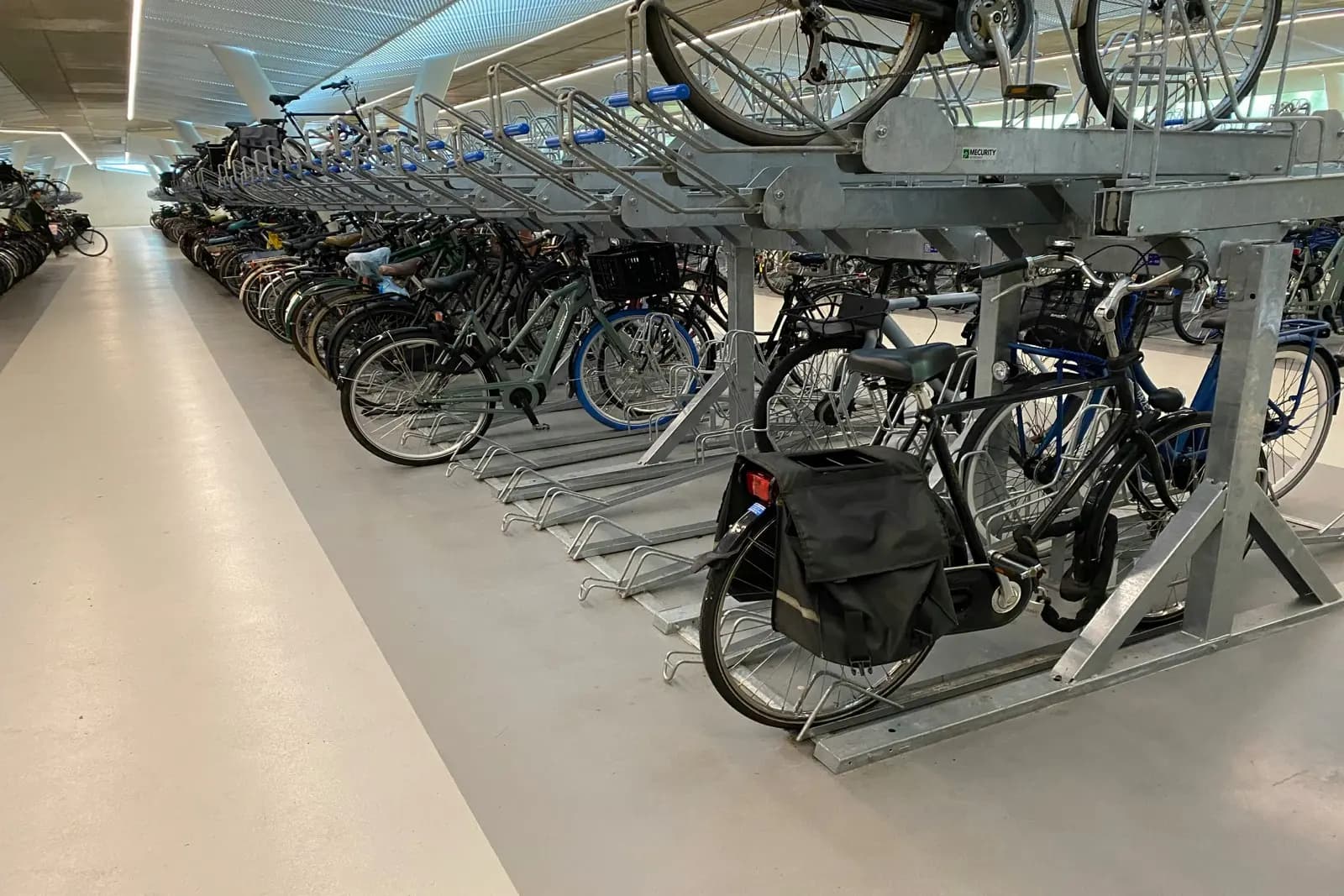
- •Wall-mounted vertical hooks, two-tier racks, or vertical floor stands for high density
- •Drainage to manage snow runoff from bikes brought in during winter
- •Card-access entry restricted to occupants
- •CCTV for theft deterrence
For developments meeting Class A long-term bike parking requirements under municipal bylaws, indoor heated bike rooms are typically the most cost-effective compliance solution per bike.
Indoor + Outdoor Hybrid
The most resilient bike parking strategy for Canadian properties combines both:
- •Indoor heated bike room for long-term Class A parking (residents, employees, students)
- •Outdoor weather-protected shelter for medium-term covered parking (employees who don't need indoor access, retail visitors during longer stays)
- •Outdoor inverted-U racks at building entrance for short-term Class B visitor parking
This three-tier system maximizes capacity while matching equipment investment to actual user duration.
Winter Maintenance for Outdoor Bike Parking
Even galvanized steel benefits from periodic maintenance:
- •Annual inspection of anchor bolts for loosening
- •Spring rinse of accumulated salt residue from racks (extends finish life)
- •Snow removal that doesn't pile snow against rack legs (creates concentrated salt exposure)
- •Drainage clearing to prevent ice formation under racks
Working With a Climate-Adapted Supplier
A bike rack supplier with Canadian climate experience provides:
- •Hot-dip galvanized steel as the standard product baseline
- •Regional snow-load engineered shelter and shed designs
- •Frost-protected foundation specifications
- •Indoor bike room design consultation
- •Year-round installation crews experienced in winter site conditions
- •Maintenance recommendations and replacement parts inventory
BikeRacks.ca supplies bike parking equipment engineered for every Canadian climate zone — from coastal BC's mild winters to Northern Ontario's -40 °C extremes — with hot-dip galvanized standard product, regional snow-load engineered shelters, and turnkey installation in all major Canadian cities. Free site assessments and climate-adapted equipment recommendations are available for any project.
Frequently Asked Questions
What is hot-dip galvanizing and why does it matter for Canadian bikes racks?
Hot-dip galvanizing dips steel into molten zinc at 450°C, forming a metallurgical bond 75–100 microns thick. The zinc layer self-heals minor scratches via cathodic action and is the same coating used on highway guardrails and bridges. ASTM A123 is the industry standard.
Can I just powder-coat steel without galvanizing for indoor racks?
For strictly indoor climate-controlled racks, yes — powder coat alone lasts decades indoors. For any outdoor exposure, you need galvanized base + powder topcoat. Powder over bare steel fails within 3–5 Canadian winters as moisture creeps under chipped paint and rusts the substrate.
Do I need to remove my e-bike battery for winter storage?
Yes — always. Lithium-ion batteries lose 20–40% capacity stored below 0°C for extended periods. Remove the battery, store indoors at 5–15°C, and ideally keep it at 40–60% charge. The bike frame and components can stay outside if covered, but the battery cannot.
Related Resources
- •Browse our full catalogue of commercial bike racks and bike shelters engineered for Canadian conditions.
- •Explore bike parking solutions by sector: residential, commercial offices, municipal, and education.
- •Local installation in major Canadian cities: Toronto, Vancouver, Montreal, Calgary, Ottawa.
- •See frequently asked questions or contact our team for a free quote in 24 hours.
Frequently Asked Questions
Where can I buy commercial bike racks in Canada?
BikeRacks.ca delivers bike racks across all 10 Canadian provinces and 3 territories. Order online or contact us for a free quote with fast shipping from our Ontario and BC warehouses.
What is the best material for outdoor bike racks in Canada?
Hot-dip galvanized steel is the best choice for outdoor installations in Canada. The zinc coating resists road salt, de-icing chemicals, and freeze-thaw cycles for 20+ years with zero maintenance.
How much do commercial bike racks cost?
Commercial bike rack prices range from $75-$2,500 depending on type, material, and quantity. Basic inverted-U racks start at about $200 installed. Volume discounts available for 10+ units.